
Privacy Policy Introduction and Overview
We have written this privacy policy (version 06.08.2026-113231350) in order to explain to you, in accordance with the provisions of the General Data Protection Regulation (EU) 2016/679 and applicable national laws, which personal data (data for short) we as the controller – and the processors commissioned by us (e.g. providers) – process, will process in the future and what legal options you have. The terms used are to be considered gender-neutral.
In short: We provide you with comprehensive information about any of your personal data we process.
Privacy policies usually sound very technical and use legal terminology. However, this privacy policy is intended to describe the most important things to you as simply and transparently as possible. So long as it aids transparency, technical terms are explained in a reader-friendly manner, links to further information are provided and graphics are used. We are thus informing in clear and simple language that we only process personal data in the context of our business activities if there is a legal basis for it. This is certainly not possible with brief, unclear and legal-technical statements, as is often standard on the internet when it comes to data protection. I hope you find the following explanations interesting and informative. Maybe you will also find some information that you have not been familiar with.
If you still have questions, we kindly ask you to contact the responsible body named below or in the imprint, follow the existing links and look at further information on third-party sites. You can of course also find our contact details in the imprint.
Scope
This privacy policy applies to all personal data processed by our company and to all personal data processed by companies commissioned by us (processors). With the term personal data, we refer to information within the meaning of Article 4 No. 1 GDPR, such as the name, email address and postal address of a person. The processing of personal data ensures that we can offer and invoice our services and products, be it online or offline. The scope of this privacy policy includes:
- all online presences (websites, online shops) that we operate
- Social media presences and email communication
- mobile apps for smartphones and other devices
In short: This privacy policy applies to all areas in which personal data is processed in a structured manner by the company via the channels mentioned. Should we enter into legal relations with you outside of these channels, we will inform you separately if necessary.
Legal bases
In the following privacy policy, we provide you with transparent information on the legal principles and regulations, i.e. the legal bases of the General Data Protection Regulation, which enable us to process personal data.
Whenever EU law is concerned, we refer to REGULATION (EU) 2016/679 OF THE EUROPEAN PARLIAMENT AND OF THE COUNCIL of April 27, 2016. You can of course access the General Data Protection Regulation of the EU online at EUR-Lex, the gateway to EU law, at https://eur-lex.europa.eu/legal-content/EN/TXT/?uri=celex%3A32016R0679.
We only process your data if at least one of the following conditions applies:
- Consent (Article 6 Paragraph 1 lit. a GDPR): You have given us your consent to process data for a specific purpose. An example would be the storage of data you entered into a contact form.
- Contract (Article 6 Paragraph 1 lit. b GDPR): We process your data in order to fulfill a contract or pre-contractual obligations with you. For example, if we conclude a sales contract with you, we need personal information in advance.
- Legal obligation (Article 6 Paragraph 1 lit. c GDPR): If we are subject to a legal obligation, we will process your data. For example, we are legally required to keep invoices for our bookkeeping. These usually contain personal data.
- Legitimate interests (Article 6 Paragraph 1 lit. f GDPR): In the case of legitimate interests that do not restrict your basic rights, we reserve the right to process personal data. For example, we have to process certain data in order to be able to operate our website securely and economically. Therefore, the processing is a legitimate interest.
Other conditions such as making recordings in the interest of the public, the exercise of official authority as well as the protection of vital interests do not usually occur with us. Should such a legal basis be relevant, it will be disclosed in the appropriate place.
In addition to the EU regulation, national laws also apply:
- In Austria this is the Austrian Data Protection Act (Datenschutzgesetz), in short DSG.
- In Germany this is the Federal Data Protection Act (Bundesdatenschutzgesetz), in short BDSG.
Should other regional or national laws apply, we will inform you about them in the following sections.
Contact details of the data protection controller
If you have any questions about data protection or the processing of personal data, you will find below the contact details of the controller in accordance with Article 4(7) of the EU General Data Protection Regulation (GDPR):
Rudi Pichler
Marienfeldweg 122
3610 Wösendorf/Wachau
Storage Period
It is a general criterion for us to store personal data only for as long as is absolutely necessary for the provision of our services and products. This means that we delete personal data as soon as any reason for the data processing no longer exists. In some cases, we are legally obliged to keep certain data stored even after the original purpose no longer exists, such as for accounting purposes.
If you want your data to be deleted or if you want to revoke your consent to data processing, the data will be deleted as soon as possible, provided there is no obligation to continue its storage.
We will inform you below about the specific duration of the respective data processing, provided we have further information.
Rights in accordance with the General Data Protection Regulation
In accordance with Articles 13, 14 of the GDPR, we inform you about the following rights you have to ensure fair and transparent processing of data:
- According to Article 15 DSGVO, you have the right to information about whether we are processing data about you. If this is the case, you have the right to receive a copy of the data and to know the following information:
- for what purpose we are processing;
- the categories, i.e. the types of data that are processed;
- who receives this data and if the data is transferred to third countries, how security can be guaranteed;
- how long the data will be stored;
- the existence of the right to rectification, erasure or restriction of processing and the right to object to processing;
- that you can lodge a complaint with a supervisory authority (links to these authorities can be found below);
- the origin of the data if we have not collected it from you;
- Whether profiling is carried out, i.e. whether data is automatically evaluated to arrive at a personal profile of you.
- You have a right to rectification of data according to Article 16 GDPR, which means that we must correct data if you find errors.
- You have the right to erasure (“right to be forgotten”) according to Article 17 GDPR, which specifically means that you may request the deletion of your data.
- According to Article 18 of the GDPR, you have the right to restriction of processing, which means that we may only store the data but not use it further.
- According to Article 20 of the GDPR, you have the right to data portability, which means that we will provide you with your data in a standard format upon request.
- According to Article 21 DSGVO, you have the right to object, which entails a change in processing after enforcement.
- If the processing of your data is based on Article 6(1)(e) (public interest, exercise of official authority) or Article 6(1)(f) (legitimate interest), you may object to the processing. We will then check as soon as possible whether we can legally comply with this objection.
- If data is used to conduct direct advertising, you may object to this type of data processing at any time. We may then no longer use your data for direct marketing.
- If data is used to conduct profiling, you may object to this type of data processing at any time. We may no longer use your data for profiling thereafter.
- According to Article 22 of the GDPR, you may have the right not to be subject to a decision based solely on automated processing (for example, profiling).
- You have the right to lodge a complaint under Article 77 of the GDPR. This means that you can complain to the data protection authority at any time if you believe that the data processing of personal data violates the GDPR.
In short: you have rights – do not hesitate to contact the responsible party listed above with us!
If you believe that the processing of your data violates data protection law or your data protection rights have been violated in any other way, you can complain to the supervisory authority. For Austria, this is the data protection authority, whose website can be found at https://www.dsb.gv.at/. In Germany, there is a data protection officer for each federal state. For more information, you can contact the Federal Commissioner for Data Protection and Freedom of Information (BfDI). The following local data protection authority is responsible for our company:
Austria Data protection authority
Manager:Dr. Matthias Schmidl
Address: Barichgasse 40-42, 1030 Wien
Phone number.: +43 1 52 152-0
E-mail address: dsb@dsb.gv.at
Website: https://www.dsb.gv.at/
Cookies
| Cookies Overview 👥 Affected parties: visitors to the website 🤝 Purpose: depending on the respective cookie. You can find out more details below or from the software manufacturer that sets the cookie. 📓 Processed data: depends on the cookie used. More details can be found below or from the manufacturer of the software that sets the cookie. 📅 Storage duration: can vary from hours to years, depending on the respective cookie ⚖️ Legal basis: Art. 6 para. 1 lit. a GDPR (consent), Art. 6 para. 1 lit. f GDPR (legitimate interests) |
What are cookies?
Our website uses HTTP-cookies to store user-specific data.
In the following we explain what cookies are and why they are used, so that you can better understand the following privacy policy.
Whenever you surf the Internet, you are using a browser. Common browsers are for example, Chrome, Safari, Firefox, Internet Explorer and Microsoft Edge. Most websites store small text-files in your browser. These files are called cookies.
It is important to note that cookies are very useful little helpers. Almost every website uses cookies. More precisely, these are HTTP cookies, as there are also other cookies for other uses. HTTP cookies are small files that our website stores on your computer. These cookie files are automatically placed into the cookie-folder, which is the “brain” of your browser. A cookie consists of a name and a value. Moreover, to define a cookie, one or multiple attributes must be specified.
Cookies store certain user data about you, such as language or personal page settings. When you re-open our website to visit again, your browser submits these “user-related” information back to our site. Thanks to cookies, our website knows who you are and offers you the settings you are familiar to. In some browsers, each cookie has its own file, while in others, such as Firefox, all cookies are stored in one single file.
The following graphic shows a possible interaction between a web browser such as Chrome and the web server. The web browser requests a website and receives a cookie back from the server. The browser then uses this again as soon as another page is requested.

There are both first-party cookies and third-party cookies. First-party cookies are created directly by our site, while third-party cookies are created by partner-websites (e.g. Google Analytics). Each cookie must be evaluated individually, as each cookie stores different data. The expiry time of a cookie also varies from a few minutes to a few years. Cookies are not software programs and do not contain viruses, trojans or other malware. Cookies also cannot access your PC’s information.
This is an example of how cookie-files can look:
Name: _ga
Value: GA1.2.1326744211.152113231350-9
Purpose: Differentiation between website visitors
Expiry date: after 2 years
A browser should support these minimum sizes:
- At least 4096 bytes per cookie
- At least 50 cookies per domain
- At least 3000 cookies in total
Which types of cookies are there?
The exact cookies that we use, depend on the used services, which will be outlined in the following sections of this privacy policy. Firstly, we will briefly focus on the different types of HTTP-cookies.
There are 4 different types of cookies:
Essential cookies
These cookies are necessary to ensure the basic functions of a website. They are needed when a user for example puts a product into their shopping cart, then continues surfing on different websites and comes back later in order to proceed to the checkout. These cookies ensure the shopping cart does not get deleted, even if the user closes their browser window.
Purposive cookies
These cookies collect information about user behaviour and whether the user receives any error messages. Furthermore, these cookies record the website’s loading time as well as its behaviour in different browsers.
Target-orientated cookies
These cookies ensure better user-friendliness. Thus, information such as previously entered locations, fonts sizes or data in forms stay stored.
Advertising cookies
These cookies are also known as targeting cookies. They serve the purpose of delivering customised advertisements to the user. This can be very practical, but also rather annoying.
Upon your first visit to a website you are usually asked which of these cookie-types you want to accept. Furthermore, this decision will of course also be stored in a cookie.
If you want to learn more about cookies and do not mind technical documentation, we recommend https://tools.ietf.org/html/rfc6265, the Request for Comments of the Internet Engineering Task Force (IETF) called “HTTP State Management Mechanism”.
Purpose of processing via cookies
The purpose ultimately depends on the respective cookie. You can find out more details below or from the software manufacturer that sets the cookie.
Which data are processed?
Cookies are little helpers for a wide variety of tasks. Unfortunately, it is not possible to tell which data is generally stored in cookies, but in the privacy policy below we will inform you on what data is processed or stored.
Storage period of cookies
The storage period depends on the respective cookie and is further specified below. Some cookies are erased after less than an hour, while others can remain on a computer for several years.
You can also influence the storage duration yourself. You can manually erase all cookies at any time in your browser (also see “Right of objection” below). Furthermore, the latest instance cookies based on consent will be erased is after you withdraw your consent. The legality of storage will remain unaffected until then.
Right of objection – how can I erase cookies?
You can decide for yourself how and whether you want to use cookies. Regardless of which service or website the cookies originate from, you always have the option of erasing, deactivating or only partially accepting cookies. You can for example block third-party cookies but allow all other cookies.
If you want to find out which cookies have been stored in your browser, or if you want to change or erase cookie settings, you can find this option in your browser settings:
Chrome: Clear, enable and manage cookies in Chrome
Safari: Manage cookies and website data in Safari
Firefox: Clear cookies and site data in Firefox
Internet Explorer: Delete and manage cookies
Microsoft Edge: Delete cookies in Microsoft Edge
If you generally do not want cookies, you can set up your browser in a way to notify you whenever a cookie is about to be set. This gives you the opportunity to manually decide to either permit or deny the placement of every single cookie. This procedure varies depending on the browser. Therefore, it might be best for you to search for the instructions in Google. If you are using Chrome, you could for example put the search term “delete cookies Chrome” or “deactivate cookies Chrome” into Google.
Legal basis
The so-called “cookie directive” has existed since 2009. It states that the storage of cookies requires your consent (Article 6 Paragraph 1 lit. a GDPR). Within countries of the EU, however, the reactions to these guidelines still vary greatly. In Austria, however, this directive was implemented in Section 165 (3) of the Telecommunications Act (2021). In Germany, the cookie guidelines have not been implemented as national law. Instead, this guideline was largely implemented in Section 15 (3) of the Telemedia Act (TMG), which has been replaced by the Digital Services Act (DSA) since May 2024.
For absolutely necessary cookies, even if no consent has been given, there are legitimate interests (Article 6 (1) (f) GDPR), which in most cases are of an economic nature. We want to offer our visitors a pleasant user experience on our website. For this, certain cookies often are absolutely necessary.
This is exclusively done with your consent, unless absolutely necessary cookies are used. The legal basis for this is Article 6 (1) (a) of the GDPR.
In the following sections you will find more detail on the use of cookies, provided the used software does use cookies.
Web hosting
| Web hosting Overview 👥 Affected parties: visitors to the website 📓 Purpose: professional hosting of the website and security of operations 🤝 Processed data: IP address, time of website visit, browser used and other data. You can find more details on this below or at the respective web hosting provider. 📅 Storage period: dependent on the respective provider, but usually 2 weeks ⚖️ Legal basis: Art. 6 para. 1 lit. f GDPR (legitimate interests) |
What is web hosting?
Every time you visit a website nowadays, certain information – including personal data – is automatically created and stored, including on this website. This data should be processed as sparingly as possible, and only with good reason. By website, we mean the entirety of all websites on your domain, i.e. everything from the homepage to the very last subpage (like this one here). By domain we mean example.uk or examplepage.com.
When you want to view a website on a screen, you use a program called a web browser. You probably know the names of some web browsers: Google Chrome, Microsoft Edge, Mozilla Firefox, and Apple Safari.
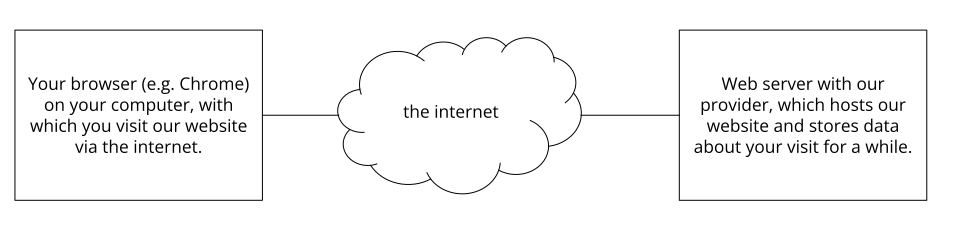
The web browser has to connect to another computer which stores the website’s code: the web server. Operating a web server is complicated and time-consuming, which is why this is usually done by professional providers. They offer web hosting and thus ensure the reliable and flawless storage of website data.
Whenever the browser on your computer establishes a connection (desktop, laptop, smartphone) and whenever data is being transferred to and from the web server, personal data may be processed. After all, your computer stores data, and the web server also has to retain the data for a period of time in order to ensure it can operate properly.
Illustration:
Why do we process personal data?
The purposes of data processing are:
- Professional hosting of the website and operational security
- To maintain the operational as well as IT security
- Anonymous evaluation of access patterns to improve our offer, and if necessary, for prosecution or the pursuit of claims.li>
Which data are processed?
Even while you are visiting our website, our web server, that is the computer on which this website is saved, usually automatically saves data such as
- the full address (URL) of the accessed website (e. g. https://www.examplepage.uk/examplesubpage.html?tid=113231350)
- browser and browser version (e.g. Chrome 87)
- the operating system used (e.g. Windows 10)
- the address (URL) of the previously visited page (referrer URL) (e. g. https://www.examplepage.uk/icamefromhere.html/)
- the host name and the IP address of the device from the website is being accessed from (e.g. COMPUTERNAME and 194.23.43.121)
- date and time
- in so-called web server log files
How long is the data stored?
Generally, the data mentioned above are stored for two weeks and are then automatically deleted. We do not pass these data on to others, but we cannot rule out the possibility that this data may be viewed by the authorities in the event of illegal conduct.
In short: Your visit is logged by our provider (company that runs our website on special computers (servers)), but we do not pass on your data without your consent!
Legal basis
The lawfulness of processing personal data in the context of web hosting is justified in Art. 6 para. 1 lit. f GDPR (safeguarding of legitimate interests), as the use of professional hosting with a provider is necessary to present the company in a safe and user-friendly manner on the internet, as well as to have the ability to track any attacks and claims, if necessary.
Webhosting Other
Contact data for our Webhosting:
Cloudways Ltd., 52 Springvale, Pope Pius XII Street, Mosta MST2653, Malta
Serverstandort: Frankfurt
You can learn more about the data processing at this provider in their Privacy Policy.
Web Analytics
| Web Analytics Privacy Policy Overview 👥 Affected parties: visitors to the website 🤝 Purpose: Evaluation of visitor information to optimise the website. 📓 Processed data: Access statistics that contain data such as access location, device data, access duration and time, navigation behaviour, click behaviour and IP addresses. You can find more details on this from the respective web analytics tool directly. 📅 Storage period: depending on the respective web analytics tool used ⚖️ Legal basis: Art. 6 para. 1 lit. a GDPR (consent), Art. 6 para. 1 lit. f GDPR (legitimate interests) |
What is Web Analytics?
We use software on our website, which is known as web analytics, in order to evaluate website visitor behaviour. Thus, data is collected, which the analytic tool provider (also called tracking tool) stores, manages and processes. Analyses of user behaviour on our website are created with this data, which we as the website operator receive. Most tools also offer various testing options. These enable us, to for example test which offers or content our visitors prefer. For this, we may show you two different offers for a limited period of time. After the test (a so-called A/B test) we know which product or content our website visitors find more interesting. For such testing as well as for various other analyses, user profiles are created and the respective data is stored in cookies.
Why do we run Web Analytics?
We have a clear goal in mind when it comes to our website: we want to offer our industry’s best website on the market. Therefore, we want to give you both, the best and most interesting offer as well as comfort when you visit our website. With web analysis tools, we can observe the behaviour of our website visitors, and then improve our website accordingly for you and for us. For example, we can see the average age of our visitors, where they come from, the times our website gets visited the most, and which content or products are particularly popular. All this information helps us to optimise our website and adapt it to your needs, interests and wishes.
Which data are processed?
The exact data that is stored depends on the analysis tools that are being used. But generally, data such as the content you view on our website are stored, as well as e. g. which buttons or links you click, when you open a page, which browser you use, which device (PC, tablet, smartphone, etc.) you visit the website with, or which computer system you use. If you have agreed that location data may also be collected, this data may also be processed by the provider of the web analysis tool.
Moreover, your IP address is also stored. According to the General Data Protection Regulation (GDPR), IP addresses are personal data. However, your IP address is usually stored in a pseudonymised form (i.e. in an unrecognisable and abbreviated form). No directly linkable data such as your name, age, address or email address are stored for testing purposes, web analyses and web optimisations. If this data is collected, it is retained in a pseudonymised form. Therefore, it cannot be used to identify you as a person.
The following example shows Google Analytics’ functionality as an example for client-based web tracking with JavaScript code.

The storage period of the respective data always depends on the provider. Some cookies only retain data for a few minutes or until you leave the website, while other cookies can store data for several years.
Duration of data processing
If we have any further information on the duration of data processing, you will find it below. We generally only process personal data for as long as is absolutely necessary to provide products and services. The storage period may be extended if it is required by law, such as for accounting purposes for example for accounting.
Right to object
You also have the option and the right to revoke your consent to the use of cookies or third-party providers at any time. This works either via our cookie management tool or via other opt-out functions. For example, you can also prevent data processing by cookies by managing, deactivating or erasing cookies in your browser.
Legal basis
The use of Web Analytics requires your consent, which we obtained with our cookie popup. According to Art. 6 para. 1 lit. a of the GDPR (consent), this consent represents the legal basis for the processing of personal data, such as by collection through Web Analytics tools.
In addition to consent, we have a legitimate interest in analysing the behaviour of website visitors, which enables us to technically and economically improve our offer. With Web Analytics, we can recognise website errors, identify attacks and improve profitability. The legal basis for this is Art. 6 para. 1 lit. f of the GDPR (legitimate interests). Nevertheless, we only use these tools if you have given your consent.
Since Web Analytics tools use cookies, we recommend you to read our privacy policy on cookies. If you want to find out which of your data are stored and processed, you should read the privacy policies of the respective tools.
If available, information on special Web Analytics tools can be found in the following sections.
Yoast SEO WordPress Plugin Privacy Policy
We use the analytics tool Yoast SEO WordPress Plugin for our website. The service provider is the Dutch company Yoast BV, Don Emanuelstraat 3, 6602 GX Wijchen, Netherlands.
To learn more about the data processed through the use of Yoast SEO WordPress Plugin, please see the Privacy Policy at https://yoast.com/privacy-policy/.
Social Media
| Social Media Privacy Policy Overview 👥 Affected parties: website visitors 🤝 Purpose: Service presentation and optimisation, staying in contact with visitors, interested parties, etc. as well as advertising 📓 Processed data: data such as telephone numbers, email addresses, contact data, data on user behaviour, information about your device and your IP address. You can find more details on this directly at the respective social media tool used. 📅 Storage period: depending on the social media platforms used ⚖️ Legal bases: Art. 6 para. 1 lit. a GDPR (consent), Art. 6 para. 1 lit. f GDPR (legitimate interests) |
What is Social Media?
In addition to our website, we are also active on various social media platforms. For us to be able to target interested users via social networks, user data may be processed. Additionally, elements of social media platforms may be embedded directly in our website. This is e.g. the case if you click a so-called social button on our website and are forwarded directly to our social media presence. So-called social media are websites and apps on which registered members can produce and exchange content with other members, be it openly or in certain groups and networks.
Why do we use Social Media?
For years, social media platforms have been the place where people communicate and get into contact online. With our social media presence, we can familiarise interested people better with our products and services. The social media elements integrated on our website help you switch to our social media content quickly and hassle free.
The data that is retained and processed when you use a social media channel is primarily used to conduct web analyses. The aim of these analyses is to be able to develop more precise and personal marketing and advertising strategies. The evaluated data on your behaviour on any social media platform can help to draw appropriate conclusions about your interests. Moreover, so-called user profiles can be created. Thus, the platforms may also to present you with customised advertisements. For this, cookies are usually placed in your browser, which store data on your user behaviour.
We generally assume that we will continue to be responsible under Data Protection Law, even when using the services of a social media platform. However, the European Court of Justice has ruled that, within the meaning of Art. 26 GDPR, in certain cases the operator of the social media platform can be jointly responsible with us. Should this be the case, we will point it out separately and work on the basis of a related agreement. You will then find the essence of the agreement for the concerned platform below.
Please note that when you use social media platforms or our built-in elements, your data may also be processed outside the European Union, as many social media channels, such as Facebook or Twitter, are American companies. As a result, you may no longer be able to easily claim or enforce your rights regarding your personal data.
Which data are processed?
Exactly which data are stored and processed depends on the respective provider of the social media platform. But usually it is data such as telephone numbers, email addresses, data you enter in contact forms, user data such as which buttons you click, what you like or who you follow, when you visited which pages, as well as information about your device and IP address. Most of this data is stored in cookies. Should you have a profile on the social media channel you are visiting and are logged in, data may be linked to your profile.
All data that are collected via social media platforms are also stored on the providers’ servers. This means that only the providers have access to the data and can provide you with appropriate information or make changes for you.
If you want to know exactly which data is stored and processed by social media providers and how you can object to the data processing, we recommend you to carefully read the privacy policy of the respective company. We also recommend you to contact the provider directly if you have any questions about data storage and data processing or if you want to assert any corresponding rights.
Duration of data processing
Provided we have any further information on this, we will inform you about the duration of the data processing below. The social media platform Facebook example stores data until they are no longer needed for the company’s own purposes. However, customer data that is synchronised with your own user data is erased within two days. Generally, we only process personal data for as long as is absolutely necessary for the provision of our services and products. This storage period can also be exceeded however, if it is required by law, such as e.g. in the case of accounting.
Right to object
You also retain the right and the option to revoke your consent to the use of cookies or third-party providers such as embedded social media elements at any time. This can be done either via our cookie management tool or via other opt-out functions. You can e.g. also prevent data collection via cookies by managing, deactivating or erasing cookies in your browser.
Since cookies may be used with social media tools, we also recommend you to read our privacy policy on cookies. If you want to find out which of your data is stored and processed, we advise you to read the privacy policies of the respective tools.
Legal basis
If you have consented to the processing and storage of your data by integrated social media elements, this consent serves as the legal basis for data processing (Art. 6 para. 1 lit. a GDPR). Generally, provided you have given your consent, your data will also be stored and processed on the basis of our legitimate interest (Art. 6 para. 1 lit. f GDPR) in maintaining fast and good communication with you and other customers and business partners. Nevertheless, we only use the tools if you have consented. Most social media platforms also set cookies on your browser to store data. We therefore recommend you to read our privacy policy on cookies carefully and to take a look at the privacy policy or cookie policy of the respective service provider.
in the following section you can find information on special social media platforms – provided this information is available.
Facebook Comments Privacy Policy
We also use the comments plugin tool by Facebook. The provider of this service is the American company Meta Platforms Inc., 1601 Willow Road, Menlo Park, CA 94025, USA.
Facebook processes data from you, among other things, in the USA. Facebook respectively Meta Platforms is an active participant in the EU-US Data Privacy Framework, which regulates the correct and secure transfer of personal data from EU citizens to the USA. More information can be found at https://commission.europa.eu/document/fa09cbad-dd7d-4684-ae60-be03fcb0fddf_en.
Additionally, Facebook uses so-called Standard Contractual Clauses (Article 46(2) and (3) GDPR). Standard Contractual Clauses (SCC) are template clauses provided by the EU Commission and are designed to ensure that your data complies with European data protection standards, even when transferred and stored in third countries (such as the USA). Through the EU-US Data Privacy Framework and the Standard Contractual Clauses, Facebook commits to maintaining the European data protection level when processing your relevant data, even if the data is stored, processed, and managed in the USA. These clauses are based on an implementing decision of the EU Commission. You can find the decision and the corresponding Standard Contractual Clauses here: https://ec.europa.eu/commission/presscorner/detail/en/ip_21_2847.
The Facebook Data Processing Term, which references the Standard Contractual Clauses, can be found at https://www.facebook.com/legal/terms/dataprocessing.
If you want to learn more about Facebook’s data protection, we recommend you the view the company’s in-house data policies at https://www.facebook.com/policy.php.
Facebook Privacy Policy
| Facebook Privacy Policy Overview 👥 Affected parties: website visitors 🤝 Purpose: service optimisation 📓 Processed data: data such as customer data, data on user behaviour, device information and IP address. You can find more details in the Privacy Policy below. 📅 Storage period: until the data no longer serves Facebook’s purposes ⚖️ Legal bases: Art. 6 para. 1 lit. a GDPR (consent), Art. 6 para. 1 lit. f GDPR (legitimate interests) |
What are Facebook tools?
We use selected Facebook tools on our website. Facebook is a social media network of the company Facebook Ireland Ltd., 4 Grand Canal Square, Grand Canal Harbour, Dublin 2 Ireland. With the aid of this tool we can provide the best possible offers to you and anyone interested in our products and services.
If your data is collected and forwarded via our embedded Facebook elements or via our Facebook page (fanpage), both we and Facebook Ireland Ltd. are responsible for this. However, should any further processing occur, then Facebook is solely responsible for this data. Our joint commitments were also set out in a publicly available agreement at https://www.facebook. com / legal / controller_addendum . It e.g. states that we must clearly inform you about the use of Facebook tools on our website. We are also responsible for ensuring that the tools are securely integrated into our website and are in accordance with the applicable privacy laws. Facebook, on the other hand, is e.g. responsible for the data security of Facebook’s products. If you have any questions about Facebook’s data collection and processing, you can contact the company directly. Should you direct the question to us, we are obliged to forward it to Facebook.
In the following we will give you an overview on the different Facebook tools, as well as on what data is sent to Facebook and how you can erase this data.
Along with many other products, Facebook also offers so called “Facebook Business Tools”. This is Facebook’s official name for its tools, but it is not very common. Therefore, we decided to merely call them “Facebook tools”. They include the following:
- Facebook-Pixel
- Social Plugins (e.g. the “Like” or “Share“ button)
- Facebook Login
- Account Kit
- APIs (application programming interface)
- SDKs (Softwart developmept kits)
- Plattform-integrations
- Plugins
- Codes
- Specifications
- Documentations
- Technologies and Services
With these tools Facebook can extend its services and is able to receive information on user activities outside of Facebook.
Why do we use Facebook tools on our website?
We only want to show our services and products to people who are genuinely interested in them. With the help of advertisements (Facebook Ads) we can reach exactly these people. However, to be able to show suitable adverts to users, Facebook requires additional information on people’s needs and wishes. Therefore, information on the user behaviour (and contact details) on our website, are provided to Facebook. Consequently, Facebook can collect better user data and is able to display suitable adverts for our products or services. Thanks to the tools it is possible to create targeted, customised ad campaigns of Facebook.
Facebook calls data about your behaviour on our website “event data” and uses them for analytics services. That way, Facebook can create “campaign reports” about our ad campaigns’ effectiveness on our behalf. Moreover, by analyses we can get a better insight in how you use our services, our website or our products. Therefore, some of these tools help us optimise your user experience on our website. With the social plugins for instance, you can share our site’s contents directly on Facebook.
What data is stored by Facebook tools?
With the use of Facebook tools, personal data (customer data) may be sent to Facebook. Depending on the tools used, customer data such as name, address, telephone number and IP address may be transmitted.
Facebook uses this information to match the data with the data it has on you (if you are a Facebook member). However, before the customer data is transferred to Facebook, a so called “Hashing” takes place. This means, that a data record of any size is transformed into a string of characters, which also has the purpose of encrypting data.
Moreover, not only contact data, but also “event data“ is transferred. These data are the information we receive about you on our website. To give an example, it allows us to see what subpages you visit or what products you buy from us. Facebook does not disclose the obtained information to third parties (such as advertisers), unless the company has an explicit permission or is legally obliged to do so. Also, “event data“ can be linked to contact information, which helps Facebook to offer improved, customised adverts. Finally, after the previously mentioned matching process, Facebook deletes the contact data.
To deliver optimised advertisements, Facebook only uses event data, if they have been combined with other data (that have been collected by Facebook in other ways). Facebook also uses event data for the purposes of security, protection, development and research. Many of these data are transmitted to Facebook via cookies. Cookies are little text files, that are used for storing data or information in browsers. Depending on the tools used, and on whether you are a Facebook member, a different number of cookies are placed in your browser. In the descriptions of the individual Facebook tools we will go into more detail on Facebook cookies. You can also find general information about the use of Facebook cookies at https://www.facebook.com/policies/cookies.
How long and where are the data stored?
Facebook fundamentally stores data, until they are no longer of use for their own services and products. Facebook has servers for storing their data all around the world. However, customer data is cleared within 48 hours after they have been matched with their own user data.
How can I erase my data or prevent data retention?
In accordance with the General Data Protection Regulation (GDPR) you have the right of information, rectification, transfer and deletion of your data.
The collected data is only fully deleted, when you delete your entire Facebook account. Deleting your Facebook account works as follows:
1) Click on settings in the top right side in Facebook.
2) Then, click “Your Facebook information“ in the left column.
3) Now click on “Deactivation and deletion”.
4) Choose “Permanently delete account“ and then click on “Continue to account deletion“.
5) Enter your password, click on “continue“ and then on “Delete account“.
The retention of data Facebook receives via our site is done via cookies (e.g. with social plugins), among others. You can deactivate, clear or manage both all and individual cookies in your browser. How this can be done differs depending on the browser you use. The following instructions show, how to manage cookies in your browser:
Chrome: Clear, enable and manage cookies in Chrome
Safari: Manage cookies and website data in Safari
Firefox: Clear cookies and site data in Firefox
Internet Explorer: Delete and manage cookies
Microsoft Edge: Delete cookies in Microsoft Edge
If you generally do not want to allow any cookies at all, you can set up your browser to notify you whenever a cookie is about to be set. This gives you the opportunity to decide upon the permission or deletion of every single cookie.
Legal basis
If you have consented to your data being processed and stored by integrated Facebook tools, this consent is the legal basis for data processing (Art. 6 para. 1 lit. a GDPR). Generally, your data is also stored and processed on the basis of our legitimate interest (Art. 6 para. 1 lit. f GDPR) to maintain fast and good communication with you or other customers and business partners. Nevertheless, we only use these tools if you have given your consent. Most social media platforms also set cookies on your browser to store data. We therefore recommend you to read our privacy policy about cookies carefully and to take a look at the privacy policy or Facebook’s cookie policy.
Facebook processes data from you, among other things, in the USA. Facebook respectively Meta Platforms is an active participant in the EU-US Data Privacy Framework, which regulates the correct and secure transfer of personal data from EU citizens to the USA. More information can be found at https://commission.europa.eu/document/fa09cbad-dd7d-4684-ae60-be03fcb0fddf_en.
Additionally, Facebook uses so-called Standard Contractual Clauses (Article 46(2) and (3) GDPR). Standard Contractual Clauses (SCC) are template clauses provided by the EU Commission and are designed to ensure that your data complies with European data protection standards, even when transferred and stored in third countries (such as the USA). Through the EU-US Data Privacy Framework and the Standard Contractual Clauses, Facebook commits to maintaining the European data protection level when processing your relevant data, even if the data is stored, processed, and managed in the USA. These clauses are based on an implementing decision of the EU Commission. You can find the decision and the corresponding Standard Contractual Clauses here: https://ec.europa.eu/commission/presscorner/detail/en/ip_21_2847.
The Facebook Data Processing Term, which references the Standard Contractual Clauses, can be found at https://www.facebook.com/legal/terms/dataprocessing.
We hope we could give you an understanding of the most important information about the use of Facebook tools and data processing. If you want to find out more on how Facebook use your data, we recommend reading the data policies at https://www.facebook.com/about/privacy/update.
Facebook Login Privacy Policy
We integrated the convenient Facebook Login to our website. With it, you can easily log into our site with your Facebook account, without having to create a new user account. If you decide to register via the Facebook Login, you will be redirected to the social media network Facebook. There, you can log in with your Facebook user data. By using this method to log in, data on you and your user behaviour is stored and transmitted to Facebook.
To save the data, Facebook uses various cookies. In the following we will show you the most significant cookies that are placed in your browser or that already exist when you log into our site via the Facebook Login:
Name: fr
Value: 0jieyh4c2GnlufEJ9..Bde09j…1.0.Bde09j
Purpose: This cookie is used to make the social plugin function optimally on our website.
Expiry date: after 3 months
Name: datr
Value: 4Jh7XUA2113231350SEmPsSfzCOO4JFFl
Purpose: Facebook sets the “datr” cookie, when a web browser accesses facebook.com. The cookie helps to identify login activities and protect users.
Expiry date: after 2 years
Name: _js_datr
Value: deleted
Purpose: Facebook sets this session cookie for tracking purposes, even if you do not have a Facebook account or are logged out.
Expiry date: after the end of the session
Note: The cookies we stated are only a small range of the cookies which are available to Facebook. Other cookies include for example _ fbp, sb or wd. It is not possible to disclose an exhaustive list, since Facebook have a multitude of cookies at their disposal which they use in variation.
On the one hand, Facebook Login enables a fast and easy registration process. On the other hand, it gives us the opportunity to share data with Facebook. In turn, we can customise our offer and advertising campaigns better to your needs and interests. The data we receive from Facebook by this means, is public data such as
- your Facebook name
- your profile picture
- your stored email address
- friends lists
- button clicks (e.g. “Like“ button)
- date of birth
- language
- place of residence
In return, we provide Facebook with information about your activities on our website. These include information on the terminal device you used, which of our subpages you visit, or what products you have bought from us.
By using Facebook Login, you agree to the data processing. You can terminate this agreement anytime. If you want to learn more about Facebook’s data processing, we recommend you to read Facebook’s Data Policy at https://www.facebook.com/policy.php.
If you are registered with Facebook, you can change your advertisement settings anytime at https://www.facebook.com/ads/preferences/?entry_product=ad_settings_screen.
Facebook Lookalike Audience Privacy Policy
We also use the advertising tool Facebook Lookalike Audience. The service provider is the American company Meta Platforms Inc. For the European area, the company Meta Platforms Ireland Limited (4 Grand Canal Square, Grand Canal Harbour, Dublin 2, Ireland) is responsible.
Meta Platforms processes data from you, among other things, in the USA. Meta Platforms is an active participant in the EU-US Data Privacy Framework, which regulates the correct and secure transfer of personal data from EU citizens to the USA. More information can be found at https://commission.europa.eu/document/fa09cbad-dd7d-4684-ae60-be03fcb0fddf_en.
Additionally, Meta Platforms uses so-called Standard Contractual Clauses (Article 46(2) and (3) GDPR). Standard Contractual Clauses (SCC) are template clauses provided by the EU Commission and are designed to ensure that your data complies with European data protection standards, even when transferred and stored in third countries (such as the USA). Through the EU-US Data Privacy Framework and the Standard Contractual Clauses, Meta Platforms commits to maintaining the European data protection level when processing your relevant data, even if the data is stored, processed, and managed in the USA. These clauses are based on an implementing decision of the EU Commission. You can find the decision and the corresponding Standard Contractual Clauses here: https://ec.europa.eu/commission/presscorner/detail/en/ip_21_2847.
The Facebook Data Processing Terms, which reference the Standard Contractual Clauses, can be found at https://www.facebook.com/legal/terms/dataprocessing.
You can learn more about the data processed through the use of Facebook Lookalike Audience in the Privacy Policy at https://www.facebook.com/about/privacy.
Facebook Social Plugins Privacy Policy
We installed so-called social plugins from Facebook Inc. to our website. You can recognise these buttons by the classic Facebook logo, the “Like” button (hand with raised thumb) or by a “Facebook plugin” label. A social plugin is a small part of Facebook that is integrated into our page. Each plugin has its own function. The most used functions are the well-known “Like” and “Share” buttons.
Facebook offers the following social plugins:
- “Save” button
- “Like” button, Share, Send and Quote
- Page plugin
- Comments
- Messenger plugin
- Embedded posts and video player
- Group Plugin
At https://developers.facebook.com/docs/plugins you will find more information on how the individual plugins are used. On the one hand, we use the social plug-ins to offer you a better user experience on our site, and on the other hand because Facebook can optimise our advertisements with it.
If you have a Facebook account or have already visited facebook.com, Facebook has already placed at least one cookie in your browser. In this case, your browser sends information to Facebook via this cookie as soon as you visit our website or interact with social plugins (e.g. the “Like” button).
The received information will be deleted or anonymised within 90 days. According to Facebook, this data includes your IP address, the websites you have visited, the date, time and other information relating to your browser.
In order to prevent Facebook from collecting much data and matching it with your Facebook data during your visit to our website, you must log out of Facebook while you visit our website.
If you are not logged in to Facebook or do not have a Facebook account, your browser sends less information to Facebook because you have fewer Facebook cookies. Nevertheless, data such as your IP address or which website you are visiting can be transmitted to Facebook. We would like to explicitly point out that we do not know what exact data is collected. However, based on our current knowledge, we want to try informing you as best we can about data processing. You can also read about how Facebook uses the data in the company’s data policy at https://www.facebook.com/about/privacy/update.
At least the following cookies are set in your browser when you visit a website with social plugins from Facebook:
Name: dpr
Value: no information
Purpose:This cookie is used to make the social plugins work on our website.
Expiry date: after end of session
Name: fr
Value: 0jieyh4113231350c2GnlufEJ9..Bde09j…1.0.Bde09j
Purpose:The cookie is also necessary for the plugins to function properly
Expiry date: after 3 months
Note: These cookies were set after our test and may be placed even if you are not a Facebook member.
If you are registered with Facebook, you can change your settings for advertisements yourself at https://www.facebook.com/ads/preferences/?entry_product=ad_settings_screen. If you are not a Facebook user, you can go to https://www.youronlinechoices.com/uk/your-ad-choices/ and manage your usage-based online advertising. There you have the option to deactivate or activate providers.
If you want to learn more about Facebook’s data protection, we recommend the company’s own data policies at https://www.facebook.com/policy.php.
Facebook Fanpage Privacy Policy
We also have a Facebook fan page for our website. The provider of this service is the American company Meta Platforms Inc. The responsible entity for the European area is the company Meta Platforms Ireland Limited (4 Grand Canal Square, Grand Canal Harbour, Dublin 2, Ireland).
Facebook processes data from you, among other things, in the USA. Facebook respectively Meta Platforms is an active participant in the EU-US Data Privacy Framework, which regulates the correct and secure transfer of personal data from EU citizens to the USA. More information can be found at https://commission.europa.eu/document/fa09cbad-dd7d-4684-ae60-be03fcb0fddf_en.
Additionally, Facebook uses so-called Standard Contractual Clauses (Article 46(2) and (3) GDPR). Standard Contractual Clauses (SCC) are template clauses provided by the EU Commission and are designed to ensure that your data complies with European data protection standards, even when transferred and stored in third countries (such as the USA). Through the EU-US Data Privacy Framework and the Standard Contractual Clauses, Facebook commits to maintaining the European data protection level when processing your relevant data, even if the data is stored, processed, and managed in the USA. These clauses are based on an implementing decision of the EU Commission. You can find the decision and the corresponding Standard Contractual Clauses here: https://ec.europa.eu/commission/presscorner/detail/en/ip_21_2847.
The Facebook Data Processing Term, which references the Standard Contractual Clauses, can be found at https://www.facebook.com/legal/terms/dataprocessing.
You can find out more about the data that is processed by using Facebook in their Privacy Policy at https://www.facebook.com/about/privacy.
Gravatar Privacy Policy
| Gravatar Privacy Policy Overview 👥 Affected parties: website visitors 🤝 Purpose: optimising our service 📓 Processed data: includes your encrypted e-mail address, IP address and our server URL More details can be found in the privacy policy below. 📅 Storage period: the data is generally deleted when it is no longer useful for the provider’s services. ⚖️ Legal bases: Art. 6 para. 1 lit. a GDPR (consent), Art. 6 para. 1 lit. f GDPR (legitimate interests) |
What is Gravatar?
We have integrated the Gravatar plugin from Automattic Inc. (60 29th Street # 343, San Francisco, CA 94110, USA) into our website. Gravatar is automatically activated on all WordPress websites. The function enables user images (avatars) to be displayed in published articles or comments, provided the respective email address is registered at www.gravatar.com.
This function sends data to Gravatar or Automattic Inc. where it gets stored and processed. In this privacy statement we would like to inform you what data this is, how the network uses it and how you can manage or prevent data retention.
Gravatar stands for “Globally Recognized Avatar” which is a globally available avatar (a user picture) that is linked to an email address. The company Gravatar is the world’s leading provider for this service. As soon as a user enters their email address which is also registered with www.gravatar.com to a website, the user’s previously stored image is automatically displayed with their post or comment.
Why do we use Gravatar on our website?
Anonymity on the internet is a popular topic. An avatar gives people that make posts or comments a face. Moreover, it makes it easier to be recognised on the web and to make oneself known. Many users enjoy the advantages of user pictures as they want to appear on the web in a personal and authentic manner. Of course, we want to offer you the possibility to display your Gravatar also on our website. Furthermore, we also like to see faces of our commenting users. With the activated Gravatar function, we are expanding the service on our website. After all, we want you to feel comfortable on our website and enable you to receive an extensive and interesting offer.
What data is stored by Gravatar?
When you publish a comment to a blogpost which requires an email address, WordPress checks whether your email address is linked to an avatar on Gravatar. For this, your email address gets encrypted and hashed and sent to Gravatar’s or Automattic’s servers, together with your IP address and our URL. Then Gravatar will check whether the email address is registered with the platform.
If the email address is registered with Gravatar, the image (gravatar) stored there will be displayed in the published comment. If you have registered your email address with Gravatar and comment on our website, further data will be transmitted to Gravatar, where it will be saved and processed. In addition to IP address and user behaviour data, this includes e.g. your browser type, the unique device identification, your preferred language, the data and time of the page visit, your operating system and information on the mobile network. Gravatar use this information to improve their services and offers and to gain better insight into the use of their service.
The following cookies are set by Automattic when a user enters an email address that is registered with Gravatar, for submitting a comment:
Name: gravatar
Value: 16b3191024acc05a238209d51ffcb92bdd710bd19113231350-7
Purpose: We could not find any exact information about the cookie.
Expiry date: after 50 years
Name: is-logged-in
Value: 1113231350-1
Purpose: This cookie stores the information that the user is logged in via the registered email address.
Expiry date: after 50 years
How long and where is the data retained?
Automattic deletes the collected data either if they are no longer used for their services, or if the company is not legally obliged to keep the data. Web server logs such as IP addresses, browser types and operating systems will be deleted after about 30 days. Until deletion, Automattic use the data to analyse traffic on their own websites (for example all WordPress sites) and to fix potential problems. The data is also stored on Automattic’s American servers.
How can I delete my data or prevent data retention?
You have the right to access and delete your personal data at any time. If you have registered with Gravatar with an email address, you can delete your account or email address there at any time.
Since images are only displayed when using an email address registered with Gravatar, and data is therefore transferred to Gravatar, you can prevent transmission of your data to Gravatar by submitting comments or articles on our website with an email address that is not registered with Gravatar.
You can manage, deactivate or delete cookies that may be set in your browser when commenting. Please note that in this case comment functions may no longer be available in their intended scope. Depending on the browser you use, the management of cookies works a little different. You can find the instructions for the most common browsers here:
Chrome: Clear, enable and manage cookies in Chrome
Safari: Manage cookies and website data in Safari
Firefox: Clear cookies and site data in Firefox
Internet Explorer: Delete and manage cookies
Microsoft Edge: Delete cookies in Microsoft Edge
Automattic is an active participant in the EU-U.S. Privacy Shield Framework which regulates correct and secure transfer of personal data. You can find more information on this at https://www.privacyshield.gov/participant?id=a2zt0000000CbqcAAC .
You can find more details on the privacy policy and what data is collected by Gravatar at https://automattic.com/privacy/ . Moreover, at https://en.gravatar.com/ you can find general information on Gravatar.
Legal basis
If you have consented to the processing and storage of you data by integrated social media elements, your consent is the legal basis for data processing (Art. 6 para. 1 lit. a GDPR) . Generally, your data is also stored and processed on the basis of our legitimate interest (Art. 6 para. 1 lit. f GDPR) to maintain fast and good communication with you or other customers and business partners. We only use the integrated social media elements if you have given your consent. Most social media platforms also place cookies in your browser to store data. We therefore recommend you to read our privacy policy about cookies and to carefully take a look at the privacy policy or the cookie policy of the respective service provider.
Gravatar processes data from you, among other things, in the USA. Automattic is an active participant in the EU-US Data Privacy Framework, which regulates the correct and secure transfer of personal data from EU citizens to the USA. More information can be found at https://commission.europa.eu/document/fa09cbad-dd7d-4684-ae60-be03fcb0fddf_en.
Additionally, Automattic uses so-called Standard Contractual Clauses (Article 46(2) and (3) GDPR). Standard Contractual Clauses (SCC) are template clauses provided by the EU Commission and are designed to ensure that your data complies with European data protection standards, even when transferred and stored in third countries (such as the USA). Through the EU-US Data Privacy Framework and the Standard Contractual Clauses, Automattic commits to maintaining the European data protection level when processing your relevant data, even if the data is stored, processed, and managed in the USA. These clauses are based on an implementing decision of the EU Commission. You can find the decision and the corresponding Standard Contractual Clauses here: https://ec.europa.eu/commission/presscorner/detail/en/ip_21_2847.
You can find out more about the standard contractual clauses and the data that is processed by Automattic in their Privacy Policy at https://automattic.com/privacy/. Moreover, you can find general information about Gravatar at http://gravatar.com/.
Instagram Privacy Policy
| Instagram Privacy Policy Overview 👥 Affected parties: website visitors 🤝 Purpose: optimising our service 📓 Processed data: includes data on user behaviour, information about your device and IP address. More details can be found in the privacy policy below. 📅 Storage period: until Instagram no longer needs the data for its purposes ⚖️ Legal basis: Art. 6 para. 1 lit. a GDPR (consent), Art. 6 para. 1 lit. f GDPR (legitimate interests) |
What is Instagram?
We have integrated functions of Instagram to our website. Instagram is a social media platform of the company Instagram LLC, 1601 Willow Rd, Menlo Park CA 94025, USA. Since 2012, Instagram is a subsidiary company of Facebook Inc. and is a part of Facebook’s products. The inclusion of Instagram’s contents on our website is called embedding. With this, we can show you Instagram contents such as buttons, photos or videos directly on our website. If you open websites of our online presence, that have an integrated Instagram function, data gets transmitted to, as well as stored and processed by Instagram. Instagram uses the same systems and technologies as Facebook. Therefore, your data will be processed across all Facebook firms.
In the following, we want to give you a more detailed insight on why Instagram collects data, what data these are and how you can control data processing. As Instagram belongs to Facebook Inc., we have, on the one hand received this information from the Instagram guidelines, and on the other hand from Facebook’s Data Policy.
Instagram is one of the most famous social media networks worldwide. Instagram combines the benefits of a blog with the benefits of audio-visual platforms such as YouTube or Vimeo. To “Insta“ (how the platform is casually called by many users) you can upload photos and short videos, edit them with different filters and also share them to other social networks. Also, if you do not want to be active on Instagram yourself, you can just follow other interesting users.
Why do we use Instagram on our website?
Instagram is a social media platform whose success has skyrocketed within recent years. Naturally, we have also reacted to this boom. We want you to feel as comfortable as possible on our website. Therefore, we attach great importance to diversified contents. With the embedded Instagram features we can enrich our content with helpful, funny or exciting Instagram contents. Since Instagram is a subsidiary company of Facebook, the collected data can also serve us for customised advertising on Facebook. Hence, only persons who are genuinely interested in our products or services can see our ads.
Instagram also uses the collected data for tracking and analysis purposes. We receive summarised statistics and therefore more insight to your wishes and interests. It is important to mention that these reports do not identify you personally.
What data is stored by Instagram?
Whenever you land on one of our sites, which have Instagram functions (i.e. Instagram photos or plugins) integrated to them, your browser automatically connects with Instagram’s servers. Thereby, data is sent to, as well as saved and processed by Instagram. This always happens, whether you have an Instagram account or not. Moreover, it includes information on our website, your computer, your purchases, the advertisements you see and on how you use our offer. The date and time of your interaction is also stored. If you have an Instagram account or are logged in, Instagram saves significantly more data on you.
Facebook distinguishes between customer data and event data. We assume this is also the case for Instagram. Customer data are for example names, addresses, phone numbers and IP addresses. These data are only transmitted to Instagram, if they have been “hashed” first. Thereby, a set of data is transformed into a string of characters, which encrypts any contact data. Moreover, the aforementioned “event data“ (data on your user behaviour) is transmitted as well. It is also possible, that contact data may get combined with event data. The collected data data is matched with any data Instagram already has on you.
Furthermore, the gathered data are transferred to Facebook via little text files (cookies) which usually get set in your browser. Depending on the Instagram function used, and whether you have an Instagram account yourself, the amount of data that gets stored varies.
We assume data processing on Instagram works the same way as on Facebook. Therefore, if you have an account on Instagram or have visited www.instagram.com, Instagram has set at least one cookie. If this is the case, your browser uses the cookie to send information to Instagram, as soon as you come across an Instagram function. No later than 90 days (after matching) the data is deleted or anonymised. Even though we have studied Instagram’s data processing in-depth, we cannot tell for sure what exact data Instagram collects and retains.
In the following we will show you a list of the least cookies placed in your browser when click on an Instagram function (e.g. button or an Insta picture). In our test we assume you do not have an Instagram account, since if you would be logged in to your Instagram account, your browser would place significantly more cookies.
The following cookies were used in our test:
Name: csrftoken
Value: “”
Purpose: This cookie is most likely set for security reasons to prevent falsifications of requests. We could not find out more information on it.
Expiry date: after one year
Name: mid
Value: “”
Purpose: Instagram places this cookie to optimise its own offers and services in- and outside of Instagram. The cookie allocates a unique user ID.
Expiry date: after end of session
Name: fbsr_113231350124024
Value: no information
Purpose: This cookie stores the login request of Instagram app users.
Expiry date: after end of session
Name: rur
Value: ATN
Purpose: This is an Instagram cookie which guarantees functionality on Instagram.
Expiry date: after end of session
Name: urlgen
Value: “{”194.96.75.33”: 1901}:1iEtYv:Y833k2_UjKvXgYe113231350”
Purpose: This cookie serves Instagram’s marketing purposes.
Expiry date: after end of session
Note: We do not claim this list to be exhaustive. The cookies that are placed in each individual case, depend on the functions embedded as well as on your use of Instagram.
How long and where are these data stored?
Instagram shares the information obtained within the Facebook businesses with external partners and persons you are globally connected with. Data processing is done according to Facebook’s internal data policy. Your data is distributed to Facebook’s servers across the world, partially for security reasons. Most of these servers are in the USA.
How can I erase my data or prevent data retention?
Thanks to the General Data Protection Regulation (GDPR), you have the right of information, rectification, transfer and deletion of your data. Furthermore, you can manage your data in Instagram’s settings. If you want to delete your data on Instagram completely, you will have to delete your Instagram account permanently.
And this is how an Instagram account can be deleted:
First, open the Instagram app. Then, navigate to your profile page, select the three bars in the top right, choose “Settings” and then click “Help”. Now, you will be redirected to the company’s website, where you must click on “Managing Your Account” and then “Delete Your Account”.
When you delete your account completely, Instagram deletes posts such as your photos and status updates. Any information other people shared about you are not a part of your account and do therefore not get deleted.
As mentioned before, Instagram primarily stores your data via cookies. You can manage, deactivate or delete these cookies in your browser. Depending on your browser, managing them varies a bit. We will show you the instructions of the most relevant browsers here.
Chrome: Clear, enable and manage cookies in Chrome
Safari: Manage cookies and website data in Safari
Firefox: Clear cookies and site data in Firefox
Internet Explorer: Delete and manage cookies
Microsoft Edge: Delete cookies in Microsoft Edge
Generally, you can set your browser to notify you whenever a cookie is about to be set. Then you can individually decide upon the permission of every cookie.
Legal basis
If you have consented to the processing and storage of your data by integrated social media elements, this consent is the legal basis for data processing (Art. 6 para. 1 lit. a GDPR) . Generally, your data is also stored and processed on the basis of our legitimate interest (Art. 6 para. 1 lit. f GDPR) to maintain fast and good communication with you or other customers and business partners. We only use the integrated social media elements if you have given your consent. Most social media platforms also place cookies in your browser to store data. We therefore recommend you to read our privacy policy about cookies carefully and to take a look at the privacy policy or the cookie policy of the respective service provider.
Instagram processes data from you, among other things, in the USA. Instagram respectively Meta Platforms is an active participant in the EU-US Data Privacy Framework, which regulates the correct and secure transfer of personal data from EU citizens to the USA. More information can be found at https://commission.europa.eu/document/fa09cbad-dd7d-4684-ae60-be03fcb0fddf_en.
Additionally, Instagram uses so-called Standard Contractual Clauses (Article 46(2) and (3) GDPR). Standard Contractual Clauses (SCC) are template clauses provided by the EU Commission and are designed to ensure that your data complies with European data protection standards, even when transferred and stored in third countries (such as the USA). Through the EU-US Data Privacy Framework and the Standard Contractual Clauses, Instagram commits to maintaining the European data protection level when processing your relevant data, even if the data is stored, processed, and managed in the USA. These clauses are based on an implementing decision of the EU Commission. You can find the decision and the corresponding Standard Contractual Clauses here: https://ec.europa.eu/commission/presscorner/detail/en/ip_21_2847.
We have tried to give you the most important information about data processing by Instagram. On https://help.instagram.com/519522125107875
you can take a closer look at Instagram’s data guidelines.
Instagram Lookalike Audience Privacy Policy
We also use the advertising tool Instagram Lookalike Audience. The service provider is the American company Meta Platforms Inc. For the European area, the company Meta Platforms Ireland Limited (4 Grand Canal Square, Grand Canal Harbour, Dublin 2, Ireland) is responsible.
Meta Platforms processes data from you, among other things, in the USA. Meta Platforms is an active participant in the EU-US Data Privacy Framework, which regulates the correct and secure transfer of personal data from EU citizens to the USA. More information can be found at https://commission.europa.eu/document/fa09cbad-dd7d-4684-ae60-be03fcb0fddf_en.
Additionally, Meta Platforms uses so-called Standard Contractual Clauses (Article 46(2) and (3) GDPR). Standard Contractual Clauses (SCC) are template clauses provided by the EU Commission and are designed to ensure that your data complies with European data protection standards, even when transferred and stored in third countries (such as the USA). Through the EU-US Data Privacy Framework and the Standard Contractual Clauses, Meta Platforms commits to maintaining the European data protection level when processing your relevant data, even if the data is stored, processed, and managed in the USA. These clauses are based on an implementing decision of the EU Commission. You can find the decision and the corresponding Standard Contractual Clauses here: https://ec.europa.eu/commission/presscorner/detail/en/ip_21_2847.
The Instagram Data Processing Terms, which reference the Standard Contractual Clauses, can be found at https://www.facebook.com/legal/terms/dataprocessing.
You can learn more about the data processed through the use of Instagram Lookalike Audience in the Privacy Policy at https://privacycenter.instagram.com/policy/.
Cookie Consent Management Platform
| Cookie Consent Management Platform Overview 👥 Affected parties: Website visitors 🤝 Purpose: Obtaining and managing consent to certain cookies and thus the use of certain tools 📓 Processed data: data for managing cookie settings such as IP address, time of consent, type of consent and individual consent. You can find more details on this directly with the tool that is being used. 📅 Storage period: depends on the tool used, periods of several years can be assumed ⚖️ Legal bases: Art. 6 para. 1 lit. a GDPR (consent), Art. 6 para. 1 lit. f GDPR (legitimate interests) |
What is a cookie consent management platform?
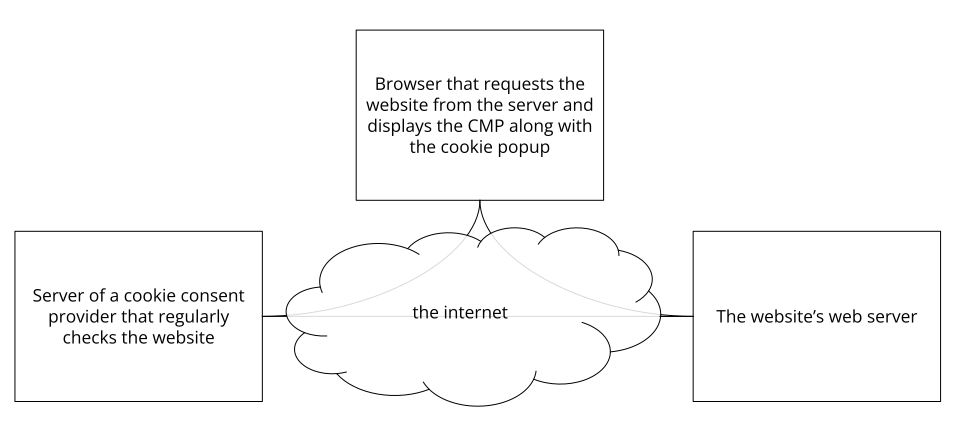
We use a Consent Management Platform (CMP) software on our website that makes it easier for us and you to handle the scripts and cookies used correctly and securely. The software automatically creates a cookie pop-up, scans and controls all scripts and cookies, provides you with the cookie consent required under data protection law and helps you and us to keep track of all cookies. Most cookie consent management tools identify and categorize all existing cookies. As a website visitor, you then decide for yourself whether and which scripts and cookies you allow or not. The following graphic shows the relationship between browser, web server and CMP.
Why do we use a cookie management tool?
Our goal is to offer you the best possible transparency in the area of data protection. We are also legally obliged to do so. We want to inform you as well as possible about all tools and all cookies that can save and process your data. It is also your right to decide for yourself which cookies you accept and which you do not. In order to grant you this right, we first need to know exactly which cookies actually landed on our website. Thanks to a cookie management tool, which regularly scans the website for all cookies present, we know about all cookies and can provide you with GDPR-compliant information. You can then use the consent system to accept or reject cookies.
Which data are processed?
As part of our cookie management tool, you can manage each individual cookie yourself and have complete control over the storage and processing of your data. The declaration of your consent is stored so that we do not have to ask you every time you visit our website and we can also prove your consent if required by law. This is saved either in an opt-in cookie or on a server. The storage time of your cookie consent varies depending on the provider of the cookie management tool. Usually this data (e.g. pseudonymous user ID, time of consent, detailed information on the cookie categories or tools, browser, device information) is stored for up to two years.
Duration of data processing
We will inform you below about the duration of the data processing if we have further information. In general, we only process personal data for as long as is absolutely necessary for the provision of our services and products. Data stored in cookies are stored for different lengths of time. Some cookies are deleted after you leave the website, others may be stored in your browser for a few years. The exact duration of the data processing depends on the tool used, in most cases you should be prepared for a storage period of several years. In the respective data protection declarations of the individual providers, you will usually receive precise information about the duration of the data processing.
Right of objection
You also have the right and the option to revoke your consent to the use of cookies at any time. This works either via our cookie management tool or via other opt-out functions. For example, you can also prevent data collection by cookies by managing, deactivating or deleting cookies in your browser.
Information on special cookie management tools can be found – if available – in the following sections.
Legal basis
If you agree to cookies, your personal data will be processed and stored via these cookies. If we are allowed to use cookies with your consent (Article 6 paragraph 1 lit. a GDPR), this consent is also the legal basis for the use of cookies and the processing of your data. In order to be able to manage the consent to cookies and to enable you to give your consent, a cookie consent management platform software is used. The use of this software enables us to operate the website in an efficient and legally compliant manner, which is a legitimate interest (Article 6 paragraph 1 lit. f GDPR).
BorlabsCookie Privacy Policy
On our website we use BorlabsCookie, which is one of the tools that store your consent to cookies. The provider of this service is the German company Borlabs – Benjamin A. Bornschein, Rübenkamp 32, 22305 Hamburg, Germany. You can find out more about the data that is processed by the use of BorlabsCookie in their Privacy Policy at https://borlabs.io/privacy/.
Audio & Video
| Audio & Video Privacy Policy Overview 👥 Affected parties: website visitors 🤝 Purpose: service optimisation 📓 Processed data: Data such as contact details, user behaviour, device information and IP addresses can be stored. You can find more details in the Privacy Policy below. 📅 Storage period: data are retained for as long as necessary for the provision of the service ⚖️ Legal bases: Art. 6 para. 1 lit. a GDPR (consent), Art. 6 para. 1 lit. f GDPR (legitimate interests) |
What are audio and video elements?
We have integrated audio and video elements to our website. Therefore, you can watch videos or listen to music/podcasts directly via our website. This content is delivered by service providers and is obtained from the respective providers’ servers.
Audio and video elements are integrated functional elements of platforms such as YouTube, Vimeo or Spotify. It is usually free of charge to use these portals, but they can also contain paid content. With the integrated elements, you can listen to or view any of their content on our website.
If you use audio or video elements on our website, your personal data may get transmitted to as well as processed and retained by service providers.
Why do we use audio & video elements on our website?
We of course want to provide you with the best offer on our website. And we are aware that content is no longer just conveyed in text and static images. Instead of just giving you a link to a video, we offer you audio and video formats directly on our website. These are entertaining or informative, but ideally they are both. Our service therefore gets expanded and it gets easier for you to access interesting content. In addition to our texts and images, we thus also offer video and/or audio content.
Which data are retained by audio & video elements?
When you visit a page on our website with e.g. an embedded video, your server connects to the service provider’s server. Thus, your data will also be transferred to the third-party provider, where it will be stored. Certain data is collected and stored regardless of whether you have an account with the third party provider or not. This usually includes your IP address, browser type, operating system and other general information about your device. Most providers also collect information on your web activity. This e.g. includes the session duration, bounce rate, the buttons you clicked or information about the website you are using the service on. This data is mostly stored via cookies or pixel tags (also known as web beacons). Any data that is pseudonymised usually gets stored in your browser via cookies. In the respective provider’s Privacy Policy, you can always find more information on the data that is stored and processed.
Duration of data processing
You can find out exactly how long the data is stored on the third-party provider’s servers either in a lower point of the respective tool’s Privacy Policy or in the provider’s Privacy Policy. Generally, personal data is only processed for as long as is absolutely necessary for the provision of our services or products. This usually also applies to third-party providers. In most cases, you can assume that certain data will be stored on third-party providers’ servers for several years. Data can be retained for different amounts of time, especially when stored in cookies. Some cookies are deleted after you leave a website, while others may be stored in your browser for a few years.
Right to object
You also retain the right and the option to revoke your consent to the use of cookies or third-party providers at any time. This can be done either via our cookie management tool or via other opt-out functions. You can e.g. also prevent data retention via cookies by managing, deactivating or erasing cookies in your browser. The legality of the processing up to the point of revocation remains unaffected.
Since the integrated audio and video functions on our site usually also use cookies, we recommend you to also read our general Privacy Policy on cookies. You can find out more about the handling and storage of your data in the Privacy Policies of the respective third party providers.
Legal basis
If you have consented to the processing and storage of your data by integrated audio and video elements, your consent is considered the legal basis for data processing (Art. 6 Para. 1 lit. a GDPR). Generally, your data is also stored and processed on the basis of our legitimate interest (Art. 6 Para. 1 lit. f GDPR) in maintaining fast and good communication with you or other customers and business partners. We only use the integrated audio and video elements if you have consented to it.
Vimeo Privacy Policy
| Vimeo Privacy Policy Overview 👥 Affected parties: website visitors 🤝 Purpose: optimising our service 📓 Processed data: Data such as contact details, data on user behaviour, information about your device and IP address may be stored. You can find more details on this in privacy policy below. 📅 Storage period: data are generally stored for as long as is necessary for the purpose of the service ⚖️ Legal basis: Art. 6 para. 1 lit. a GDPR (consent), Art. 6 para. 1 lit. f GDPR (legitimate interests) |
What is Vimeo?
On our website, we use videos of the company Vimeo. This video portal is operated by Vimeo LLC, 555 West 18th Street, New York, New York 10011, USA. With the help of a plug-in, we can display interesting video material directly on our website. Consequently, some of your data may be transmitted to Vimeo. In this privacy policy we want to explain to you what data this is, why we use Vimeo and how you can manage your data or prevent data transmission.
Vimeo is a video platform that was founded in 2004 and introduced video streaming in HD quality in 2007. Since 2015 it has been possible to stream in 4k Ultra HD. The use of the portal is free of charge, but it also contains certain paid content. Compared to the market leader YouTube, Vimeo attaches great importance to valuable content in good quality. On the one hand, the portal offers a lot of artistic content such as music videos and short films. On the other hand, it also offers useful documentaries on a broad spectrum of topics.
Why do we use Vimeo on our website?
The aim of our website is to provide you the best possible content, in the easiest and most accessible way we can. We will only be satisfied with our service, once we have reached that goal. The video service Vimeo supports us in achieving this goal. Vimeo gives us the opportunity to present high quality content to you directly on our website. Instead of us merely giving you a link to an interesting video, you can watch the video here with us. This extends our service and makes it easier for you to access interesting content. Therefore, in addition to our texts and images, we can also offer video content.
What data is stored on Vimeo?
When you open a site on our website that has a Vimeo video embedded to it, your browser will connect to Vimeo’s servers, and a data transmission will take place. The data are then collected, stored and processed on Vimeo’s servers. Regardless of whether you have a Vimeo account or not, Vimeo collects data about you. This includes your IP address, technical information about your browser type, your operating system or very basic device information. Furthermore, Vimeo store information on what website you use their service on and which actions (web activities) you carry out on our website. These web activities include e.g. session duration, bounce rate or which button you clicked on our site that contains a Vimeo function. Vimeo can track and store these actions using cookies and similar technologies.
If you are logged in as a registered member of Vimeo, more data may be collected, since a bigger number of cookies may already have been set in your browser. Furthermore, your actions on our website are directly linked to your Vimeo account. To prevent this, you must log out of Vimeo while “surfing” our website.
Below we will show you an array of cookies Vimeo sets when you are on a website containing an integrated Vimeo function. This list is not exhaustive and assumes that you do not have a Vimeo account.
Name: player
Value: “”
Purpose: This cookie saves your settings before you play an embedded Vimeo video. This will ensure you to receive your preferred settings again next time you watch a Vimeo video.
Expiry date: after one year
Name: vuid
Value: pl1046149876.614422590113231350-4
Purpose: This cookie collects information about your actions on websites that have a Vimeo video embedded to them.
Expiry date: after 2 years
Note: These two cookies are set every time as soon as you are on a website that has a Vimeo video embedded to it. If you watch the video and click a button such as “share” or “like”, additional cookies will be set. These can also be third-party cookies such as _ga or _gat_UA-76641-8 from Google Analytics or _fbp from Facebook. The exact cookies that are set depends on your interaction with the video.
The following list will show a selection of cookies that could be placed when you interact with a Vimeo video:
Name: _abexps
Value: %5B%5D
Purpose: This Vimeo cookie helps Vimeo to remember your settings. For example, this can be a pre-set language, a region or a username. The cookie generally stores data on how you use Vimeo.
Expiry date: after one year
Name: continuous_play_v3
Value: 1
Purpose: This cookie is a first-party cookie from Vimeo. The cookie collects information on how you use Vimeo’s service. For example, the cookie stores details on when you pause a video and resume it.
Expiry date: after one year
Name: _ga
Value: GA1.2.1522249635.1578401280113231350-7
Purpose: This cookie is a third-party cookie from Google. By default, analytics.js uses the _ga cookie to store the user ID. Thus, it serves to differentiate between website visitors.
Expiry date: after 2 years
Name: _gcl_au
Value: 1.1.770887836.1578401279113231350-3
Purpose: This third-party cookie from Google AdSense is used to improve the efficiency of ads on websites.
Expiry date: after 3 months
Name: _fbp
Value: fb.1.1578401280585.310434968
Purpose:This is a Facebook cookie. It is used to display adverts or advertising products from Facebook or other advertisers.
Expiry date: after 3 months
Vimeo use this data to improve their own service, to communicate with you and to implement their own targeted advertising measures. On their website they emphasise that only first-party cookies (i.e. cookies from Vimeo itself) are used for embedded videos, provided you do not interact with the video.
How long and where is the data stored?
Vimeo is headquartered in White Plains, New York (USA). However, their services are offered worldwide. For this, the company uses computer systems, databases and servers in the United States and other countries. Thus, your data may also be stored and processed on servers in America. Vimeo stores the data until the company no longer has an economical reason for keeping it. Then the data will be deleted or anonymised. Vimeo correspond to the EU-U.S. Privacy Shield Framework and are therefore allowed to collect and use information from users within the EU, and to transfer this data to the USA.
How can I erase my data or prevent data retention?
You always have the option to manage cookies in your browser. If you do not want Vimeo to set cookies and collect information about you for example, you can delete or deactivate cookies in your browser settings at any time. These settings vary a little depending on the browser. Please note that after deactivating/deleting cookies, various functions may no longer be fully available. The following instructions show how you can manage or delete cookies in your browser.
Chrome: Clear, enable and manage cookies in Chrome
Safari: Manage cookies and website data in Safari
Firefox: Clear cookies and site data in Firefox
Internet Explorer: Delete and manage cookies
Microsoft Edge: Delete cookies in Microsoft Edge
If you are a registered Vimeo member, you can also manage cookies in Vimeo’s settings.
Legal basis
If you have consented to the processing and storage of your data by integrated Vimeo elements, this consent is the legal basis for data processing (Art. 6 para. 1 lit. a GDPR) . Generally, your data is also stored and processed on the basis of our legitimate interest (Art. 6 para. 1 lit. f GDPR) to maintain fast and good communication with you or other customers and business partners. Nevertheless, we only use integrated Vimeo elements if you have given your consent. Vimeo also sets cookies in your browser to store data. We therefore recommend you to read our privacy policy on cookies carefully and to take a look at the privacy policy or the cookie policy of the respective service provider.
Vimeo also processes data in the USA, among other countries. We would like to note, that according to the European Court of Justice, there is currently no adequate level of protection for data transfers to the USA. This can be associated with various risks to the legality and security of data processing.
Vimeo uses standard contractual clauses approved by the EU Commission as basis for data processing by recipients based in third countries (outside the European Union, Iceland, Liechtenstein, Norway, and especially in the USA) or data transfer there (= Art. 46, paragraphs 2 and 3 of the GDPR). These clauses oblige Vimeo to comply with the EU‘s level of data protection when processing relevant data outside the EU. These clauses are based on an implementing order by the EU Commission. You can find the order and the clauses here: https://ec.europa.eu/commission/presscorner/detail/en/ip_21_2847
You can find out more about the use of cookies at Vimeo at https://vimeo.com/cookie_policy. Furthermore, you can find more information on privacy at Vimeo at https://vimeo.com/privacy.
YouTube Data API Privacy Policy
We also use the YouTube feature YouTube Data API. The provider of this service is the American company Google Inc. The responsible entity for the European region is the Irish company Google Ireland Limited (Gordon House, Barrow Street Dublin 4, Irland).
Google processes data from you, among other things, in the USA. Google is an active participant in the EU-US Data Privacy Framework, which regulates the correct and secure transfer of personal data from EU citizens to the USA. More information can be found at https://commission.europa.eu/document/fa09cbad-dd7d-4684-ae60-be03fcb0fddf_en.
Additionally, Google uses so-called Standard Contractual Clauses (Article 46(2) and (3) GDPR). Standard Contractual Clauses (SCC) are template clauses provided by the EU Commission and are designed to ensure that your data complies with European data protection standards, even when transferred and stored in third countries (such as the USA). Through the EU-US Data Privacy Framework and the Standard Contractual Clauses, Google commits to maintaining the European data protection level when processing your relevant data, even if the data is stored, processed, and managed in the USA. These clauses are based on an implementing decision of the EU Commission. You can find the decision and the corresponding Standard Contractual Clauses here: https://ec.europa.eu/commission/presscorner/detail/en/ip_21_2847.
You can find the Google Ads Data Processing Terms, which refer to the Standard Contractual Clauses, at: https://business.safety.google/intl/en/adsprocessorterms/
You can find out more about Googles’ data processing in their privacy policy at https://policies.google.com/privacy?hl=en-US.
YouTube Privacy Policy
| YouTube Privacy Policy Overview 👥 Affected parties: website visitors 🤝 Purpose: optimising our service 📓 Processed data: Data such as contact details, data on user behaviour, information about your device and IP address may be stored. You can find more details on this in the privacy policy below. 📅 Storage period: data are generally stored for as long as is necessary for the purpose of the service ⚖️ Legal bases: Art. 6 para. 1 lit. a GDPR (consent), Art. 6 para. 1 lit. f GDPR (legitimate interests) |
What is YouTube?
We have integrated YouTube videos to our website. Therefore, we can show you interesting videos directly on our site. YouTube is a video portal, which has been a subsidiary company of Google LLC since 2006. The video portal is operated by YouTube, LLC, 901 Cherry Ave., San Bruno, CA 94066, USA. When you visit a page on our website that contains an embedded YouTube video, your browser automatically connects to the servers of YouTube or Google. Thereby, certain data are transferred (depending on the settings). Google is responsible for YouTube’s data processing and therefore Google’s data protection applies.
In the following we will explain in more detail which data is processed, why we have integrated YouTube videos and how you can manage or clear your data.
On YouTube, users can watch, rate, comment or upload videos for free. Over the past few years, YouTube has become one of the most important social media channels worldwide. For us to be able to display videos on our website, YouTube provides a code snippet that we have integrated to our website.
Why do we use YouTube videos on our website?
YouTube is the video platform with the most visitors and best content. We strive to offer you the best possible user experience on our website, which of course includes interesting videos. With the help of our embedded videos, we can provide you other helpful content in addition to our texts and images. Additionally, embedded videos make it easier for our website to be found on the Google search engine. Moreover, if we place ads via Google Ads, Google only shows these ads to people who are interested in our offers, thanks to the collected data.
What data is stored by YouTube?
As soon as you visit one of our pages with an integrated YouTube, YouTube places at least one cookie that stores your IP address and our URL. If you are logged into your YouTube account, by using cookies YouTube can usually associate your interactions on our website with your profile. This includes data such as session duration, bounce rate, approximate location, technical information such as browser type, screen resolution or your Internet provider. Additional data can include contact details, potential ratings, shared content via social media or YouTube videos you added to your favourites.
If you are not logged in to a Google or YouTube account, Google stores data with a unique identifier linked to your device, browser or app. Thereby, e.g. your preferred language setting is maintained. However, many interaction data cannot be saved since less cookies are set.
In the following list we show you cookies that were placed in the browser during a test. On the one hand, we show cookies that were set without being logged into a YouTube account. On the other hand, we show you what cookies were placed while being logged in. We do not claim for this list to be exhaustive, as user data always depend on how you interact with YouTube.
Name: YSC
Value: b9-CV6ojI5Y113231350-1
Purpose: This cookie registers a unique ID to store statistics of the video that was viewed.
Expiry date: after end of session
Name: PREF
Value: f1=50000000
Purpose: This cookie also registers your unique ID. Google receives statistics via PREF on how you use YouTube videos on our website.
Expiry date: after 8 months
Name: GPS
Value: 1
Purpose: This cookie registers your unique ID on mobile devices to track GPS locations.
Expiry date: after 30 minutes
Name: VISITOR_INFO1_LIVE
Value: 95Chz8bagyU
Purpose: This cookie tries to estimate the user’s internet bandwith on our sites (that have built-in YouTube videos).
Expiry date: after 8 months
Further cookies that are placed when you are logged into your YouTube account:
Name: APISID
Value: zILlvClZSkqGsSwI/AU1aZI6HY7113231350-
Purpose: This cookie is used to create a profile on your interests. This data is then used for personalised advertisements.
Expiry date: after 2 years
Name: CONSENT
Value: YES+AT.de+20150628-20-0
Purpose: The cookie stores the status of a user’s consent to the use of various Google services. CONSENT also provides safety measures to protect users from unauthorised attacks.
Expiry date: after 19 years
Name: HSID
Value: AcRwpgUik9Dveht0I
Purpose: This cookie is used to create a profile on your interests. This data helps to display customised ads.
Expiry date: after 2 years
Name: LOGIN_INFO
Value: AFmmF2swRQIhALl6aL…
Purpose: This cookie stores information on your login data.
Expiry date: after 2 years
Name: SAPISID
Value: 7oaPxoG-pZsJuuF5/AnUdDUIsJ9iJz2vdM
Purpose: This cookie identifies your browser and device. It is used to create a profile on your interests.
Expiry date: after 2 years
Name: SID
Value: oQfNKjAsI113231350-
Purpose: This cookie stores your Google Account ID and your last login time, in a digitally signed and encrypted form.
Expiry date: after 2 years
Name: SIDCC
Value: AN0-TYuqub2JOcDTyL
Purpose: This cookie stores information on how you use the website and on what advertisements you may have seen before visiting our website.
Expiry date: after 3 months
How long and where is the data stored?
The data YouTube receive and process on you are stored on Google’s servers. Most of these servers are in America. At https://datacenters.google/ you can see where Google’s data centres are located. Your data is distributed across the servers. Therefore, the data can be retrieved quicker and is better protected against manipulation.
Google stores collected data for different periods of time. You can delete some data anytime, while other data are automatically deleted after a certain time, and still other data are stored by Google for a long time. Some data (such as elements on “My activity”, photos, documents or products) that are saved in your Google account are stored until you delete them. Moreover, you can delete some data associated with your device, browser, or app, even if you are not signed into a Google Account.
How can I erase my data or prevent data retention?
Generally, you can delete data manually in your Google account. Furthermore, in 2019 an automatic deletion of location and activity data was introduced. Depending on what you decide on, it deletes stored information either after 3 or 18 months.
Regardless of whether you have a Google account or not, you can set your browser to delete or deactivate cookies placed by Google. These settings vary depending on the browser you use. The following instructions will show how to manage cookies in your browser:
Chrome: Clear, enable and manage cookies in Chrome
Safari: Manage cookies and website data in Safari
Firefox: Clear cookies and site data in Firefox
Internet Explorer: Delete and manage cookies
Microsoft Edge: Delete cookies in Microsoft Edge
If you generally do not want to allow any cookies, you can set your browser to always notify you when a cookie is about to be set. This will enable you to decide to either allow or permit each individual cookie.
Legal basis
If you have consented processing and storage of your data by integrated YouTube elements, this consent is the legal basis for data processing (Art. 6 para. 1 lit. a GDPR). Generally, your data is also stored and processed on the basis of our legitimate interest (Art. 6 para. 1 lit. f GDPR) to maintain fast and good communication with you or other customers and business partners. Nevertheless, we only use integrated YouTube elements if you have given your consent. YouTube also sets cookies in your browser to store data. We therefore recommend you to read our privacy policy on cookies carefully and to take a look at the privacy policy or the cookie policy of the respective service provider.
Google processes data from you, among other things, in the USA. Google is an active participant in the EU-US Data Privacy Framework, which regulates the correct and secure transfer of personal data from EU citizens to the USA. More information can be found at https://commission.europa.eu/document/fa09cbad-dd7d-4684-ae60-be03fcb0fddf_en.
Additionally, Google uses so-called Standard Contractual Clauses (Article 46(2) and (3) GDPR). Standard Contractual Clauses (SCC) are template clauses provided by the EU Commission and are designed to ensure that your data complies with European data protection standards, even when transferred and stored in third countries (such as the USA). Through the EU-US Data Privacy Framework and the Standard Contractual Clauses, Google commits to maintaining the European data protection level when processing your relevant data, even if the data is stored, processed, and managed in the USA. These clauses are based on an implementing decision of the EU Commission. You can find the decision and the corresponding Standard Contractual Clauses here: https://ec.europa.eu/commission/presscorner/detail/en/ip_21_2847.
You can find the Google Ads Data Processing Terms, which refer to the Standard Contractual Clauses, at: https://business.safety.google/intl/en/adsprocessorterms/
Since YouTube is a subsidiary company of Google, Google’s privacy statement applies to both. If you want to learn more about how your data is handled, we recommend the privacy policy at https://policies.google.com/privacy?hl=en.
YouTube Subscribe Button Privacy Policy
We have integrated the YouTube subscribe button to our website, which you can recognise by the classic YouTube logo. The logo shows the words “Subscribe” or “YouTube” in white letters against a red background, with a white “Play” symbol on the left. The button may also be displayed in a different design.
Our YouTube channel consistently offers you funny, interesting or exciting videos. With the built-in “Subscribe” button you can subscribe to our channel directly via our website and do not need to go to YouTube’s website for it. With this feature, we want to make it as easy as possible for you to access our comprehensive content. Please note that YouTube may save and process your data.
If you see a built-in subscription button on our page, YouTube sets at least one cookie, according to Google. This cookie stores your IP address and our URL. It also allows YouTube to receive information about your browser, your approximate location and your default language. In our test the following four cookies were placed, without us being logged into YouTube:
Name: YSC
Value: b9-CV6ojI5113231350Y
Purpose: This cookie registers a unique ID, which stores statistics of the viewed video.
Expiry date: after end of session
Name: PREF
Value: f1=50000000
Purpose:This cookie also registers your unique ID. Google uses PREF to get statistics on how you interact with YouTube videos on our website.
Expiry date: after 8 months
Name: GPS
Value: 1
Purpose:This cookie registers your unique ID on mobile devices to track your GPS location.
Expiry date: after 30 minutes
Name: VISITOR_INFO1_LIVE
Value: 11323135095Chz8bagyU
Purpose: This cookie tries to estimate the user’s internet bandwith on our website (that contain built-in YouTube video).
Expiry date: after 8 months
Note: These cookies were set after a test, thus we do not claim for the list to be exhaustive.
If you are logged into your YouTube account, YouTube may store many of the actions and interactions you make on our website via cookies, to then assign them to your YouTube account. This gives YouTube information on e.g. how long you have been browsing our website, which browser type you use, which screen resolution you prefer or what actions you take.
On the one hand, YouTube uses this data to improve its own services and offers, and on the other hand to provide analyses and statistics for advertisers (who use Google Ads).
YouTube IFrame Player Privacy Policy
We also use the YouTube IFrame Player to embed videos on our website. The provider of this service is the American company Google Inc. The responsible entity for the European region is the Irish company Google Ireland Limited (Gordon House, Barrow Street Dublin 4, Irland).
Google processes data from you, among other things, in the USA. Google is an active participant in the EU-US Data Privacy Framework, which regulates the correct and secure transfer of personal data from EU citizens to the USA. More information can be found at https://commission.europa.eu/document/fa09cbad-dd7d-4684-ae60-be03fcb0fddf_en.
Additionally, Google uses so-called Standard Contractual Clauses (Article 46(2) and (3) GDPR). Standard Contractual Clauses (SCC) are template clauses provided by the EU Commission and are designed to ensure that your data complies with European data protection standards, even when transferred and stored in third countries (such as the USA). Through the EU-US Data Privacy Framework and the Standard Contractual Clauses, Google commits to maintaining the European data protection level when processing your relevant data, even if the data is stored, processed, and managed in the USA. These clauses are based on an implementing decision of the EU Commission. You can find the decision and the corresponding Standard Contractual Clauses here: https://ec.europa.eu/commission/presscorner/detail/en/ip_21_2847.
You can find the Google Ads Data Processing Terms, which refer to the Standard Contractual Clauses, at: https://business.safety.google/intl/en/adsprocessorterms/
You can find out more about Googles’ data processing in their privacy policy at https://policies.google.com/privacy?hl=en-US.
YouTube-Video-Widget Privacy Policy
We also use the video widget by YouTube on our website. The provider of this service is the American company Google Inc. The responsible entity for the European region is the Irish company Google Ireland Limited (Gordon House, Barrow Street Dublin 4, Irland).
Google processes data from you, among other things, in the USA. Google is an active participant in the EU-US Data Privacy Framework, which regulates the correct and secure transfer of personal data from EU citizens to the USA. More information can be found at https://commission.europa.eu/document/fa09cbad-dd7d-4684-ae60-be03fcb0fddf_en.
Additionally, Google uses so-called Standard Contractual Clauses (Article 46(2) and (3) GDPR). Standard Contractual Clauses (SCC) are template clauses provided by the EU Commission and are designed to ensure that your data complies with European data protection standards, even when transferred and stored in third countries (such as the USA). Through the EU-US Data Privacy Framework and the Standard Contractual Clauses, Google commits to maintaining the European data protection level when processing your relevant data, even if the data is stored, processed, and managed in the USA. These clauses are based on an implementing decision of the EU Commission. You can find the decision and the corresponding Standard Contractual Clauses here: https://ec.europa.eu/commission/presscorner/detail/en/ip_21_2847.
You can find the Google Ads Data Processing Terms, which refer to the Standard Contractual Clauses, at: https://business.safety.google/intl/en/adsprocessorterms/
You can find out more about Googles’ data processing in their privacy policy at https://policies.google.com/privacy?hl=en-US.
Online Map Services Introduction
| Online Map Services Privacy Policy Overview 👥 Affected parties: website visitors 🤝 Purpose: Improvement of user experience 📓 Processed data: the data that is processed depends heavily on the services used. Usually, it is your IP address, location data, search queries and/or technical data. You can find more details on this under the respective tools used. 📅 Storage duration: depends on the tools used ⚖️ Legal bases: Article 6 paragraph 1 lit. a GDPR (consent), Article 6 paragraph 1 lit. f GDPR (legitimate interests) |
What are Online Map Services?
We also use online map services for our website as an extended service. Google Maps is probably the service you are most familiar with. But there are also other providers out there that specialise in creating digital maps. These services allow the display of locations, route maps or other geographical information directly via our website. Thanks to an integrated map service, you no longer have to leave our website to e. g. view the route to a location. In order to ensure that the online map can run on our website, we have integrated map sections within our HTML code. This way the services can display street maps, the earth’s surface, or aerial or satellite imagery. If you use the built-in map service, your data will be transferred to the tool used, where it will be retained. This may also include your personal data.
Why do we use Online Map Services on our website?
Generally speaking, it is imperative for us to offer you a pleasant time on our website. Of course, we know that you will most likely only enjoy your time here if you can easily find your way around and find all the information you need quickly and easily. Therefore, we decided that an online map system may be a significant optimisation of our website’s service. After all, you can use the map system to easily view route descriptions, locations or any other points of interest – without leaving our site. Needless to say, it is certainly also very practical that you can easily see where our company headquarters are so that you can find us quickly and safely. As you can see, there are just a lot of advantages – and we clearly consider online map services on our website to be part of our customer service.
What data is stored by Online Map Services?
If you open a page on our website with an online map function installed, your personal data may be transmitted to the relevant service, where it may be stored. This usually includes your IP address, which may also be used to determine your approximate location. In addition to your IP address, data such as the search terms you entered, as well as your longitude and latitude coordinates will be stored. If you e. g. enter an address for route planning, this data will also be stored. This data is not stored by us but instead on the servers of the integrated tools. You can think of it like this: You may be on our website, but when you interact with a mapping service, that interaction is actually happening on their website. Moreover, in order for the service to function properly, at least one cookie is usually set in your browser. As an example, Google Maps also uses cookies to record user behaviour, with which it can optimise its own service and offer personalised advertising. You can find out more about cookies in our “Cookies” section.
How long and where is the data stored?
Every online map service processes different user data. Provided we have further information, we will inform you about the duration of data processing in the corresponding sections on the individual tools below. Generally, personal data is only retained for as long as is necessary to provide the service. Google Maps e. g. stores certain data for a specified period of time, but you must erase other data yourself. At Mapbox, for example, your IP address is stored for 30 days after which it is deleted. As you can see, each tool stores data for different lengths of time. We thus recommend you take a closer look at the privacy policies of the tools used.
The providers may use cookies to store data on your user behaviour in relation to their map services. You can find more information about cookies in our “Cookies” section, but in the individual providers’ privacy policies you can most probably also find out which cookies may be used. In most cases, however, this is only an indicative list and is not exhaustive.
Right to object
You always have the possibility and the right to access your personal data and to object to its use and processing. You can also revoke the consent you gave to us at any time. This is usually easiest through the cookie consent tool. However, there are other opt-out tools that you can use. You can also manage, erase or deactivate any cookies set by the used providers yourself with just a few mouse clicks. However, this may lead to some service functions stopping to work as usual. It also depends on your browser how you can manage cookies there. In our “Cookies” section you will find links to instructions of the most popular browsers.
Legal Basis
If you have agreed to the use of an online map service, the legal basis for the corresponding data processing is this consent. According to Article 6 Paragraph 1 lit. (consent) this consent is the legal basis for the processing of personal data as may occur when collected by an online map service.
We also have a legitimate interest in using an online map service to optimise our service on our website. The corresponding legal basis for this is Article 6 (1) (f) GDPR (legitimate interests). However, we only use an online map service if you have given your consent. We definitely wanted to stress this point once again.
You can find information on specific online map services – if available – in the following sections.
Google Maps Privacy Policy
| Google Maps Privacy Policy Overview 👥 Affected parties: website visitors 🤝 Purpose: service optimisation 📓 Processed data: data such as entered search terms, IP address as well as latitude and longitude coordinates. You can find more details on this in the Privacy Policy below. 📅 Storage duration: depending on the retained data ⚖️ Legal bases: Art. 6 para. 1 lit. a GDPR (consent), Art. 6 para. 1 lit. f GDPR (legitimate interests) |
What is Google Maps?
On our website we use Google Maps of the company Google Inc. (1600 Amphitheatre Parkway Mountain View, CA 94043, USA). With the use of Google Maps, we can show you locations in a better way and can therefore adjust our service to your needs. Due to the utilisation of Google Maps, data gets transferred to Google and is saved on Google’s servers. In the following, we want to explain in detail what Google Maps is, why we use this Google service, what data is stored and how you can prevent this.
Google Maps is an internet maps service of the company Google Inc. With Google Maps you can search for exact locations of cities, sights, accommodations or businesses online via a PC, a tablet or an app. If businesses are represented on Google My Business, the respective location as well as other information about the company are shown there. In order to show route directions, a location’s map sections can be integrated in a website through a HTML-code. Google Maps depicts the earth’s surface as either a road map or as air and satellite images. Due to the street view and high-quality satellite images, it is possible for exact representations to be made.
Why do we use Google Maps on our website?
The efforts we make on this page have the goal of giving you a useful and meaningful experience on our website. Through the integration of Google Maps, we can offer you essential information on various locations. Therefore, you can spot our office address with one glance. Furthermore, the route directions always show you the best and fastest way to us. You can retrieve the route directions for traveling either by car, by public transport, on foot or by bike. The integration of Google Maps is a part of our customer service.
What data is stored by Google Maps?
For Google Maps to offer its full services, the company must collect and store your data. This includes your entered search terms, your IP-address as well as your longitude and latitude coordinates. When you use the route-planner function, the entered start address is stored also. However, this data retention happens on Google Maps‘ websites. We can only inform you about it but cannot influence it in any way. Since we have included Google Maps on our website, Google will set at least one cookie (Name: NID) into your browser. This cookie saves data on your user behaviour. Google primarily uses this data to optimise ist own services and to provide you with individual, personalised advertisements.
The following cookies are set in your browser due to the integration of Google Maps:
Name: NID
Value: 188=h26c1Ktha7fCQTx8rXgLyATyITJ113231350-5
Purpose: Google uses NID in order to adjust advertisments to your Google searches. With the cookie’s help Google “remembers“ your most frequently entered search queries or your previous interaction with ads. That way you always receive customised adertisments. The cookie contains a unique ID, wich Google uses to collect your personal settings for advertising porposes.
Expiration date: after 6 months
Note: We cannot guarantee completeness of the information on saved data. This is, because especially concerning the use of cookies, changes can happen anytime. To identify the cookie NID, a test page was created, to which Google Maps was included.
How long and where is the data stored?
There are Google servers in data centres across the entire planet. However, most servers are in America. For this reason, your data is widely stored in the USA. Here you can read in detail about where the Google servers are located: https://datacenters.google/
Google distributes data to various data carriers. This makes it possible to retrieve the data faster and to better protect it from possible attempted manipulations. Every server has emergency programs. Thus, should for example a problem with Google’s hardware occur or should a natural disaster impact the servers, any data will quite certainly stay protected.
Moreover, Google saves some data for a specified period. With some other data on the other hand, Google only offers the opportunity for deleting it manually. Furthermore, the company anonymises information (e.g. advertising data) in server logs, by deleting a part of the IP-address and cookie information after 9 to 18 months.
How can I erase my data, or prevent data retention?
Due to the automatic delete function for location and activity data, which was introduced in 2019, information that is used for determining your location and web or app activity is saved for either 3 or 18 months, depending on your preferred decision, and is deleted thereafter. Furthermore, it is possible to delete this data manually from your browser history via your Google account anytime. If you want to prevent the determination of your location altogether, you must pause the category “Web and app activity” in your Google account. Click on “Data and personalisation” and then choose the option “Activity controls”. Here you can switch the activities on or off.
Moreover, in your browser you can deactivate, delete or manage individual cookies. This function can differ a little, depending on what browser you are using. The following instructions will show you how to manage cookies in your browser:
Chrome: Clear, enable and manage cookies in Chrome
Safari: Manage cookies and website data in Safari
Firefox: Clear cookies and site data in Firefox
Internet Explorer: Delete and manage cookies
Microsoft Edge: Delete cookies in Microsoft Edge
If you generally do not want to permit any cookies, you can set up your browser in a way that ensures you get informed whenever a cookie is about to be placed. That way you can decide to either permit or refuse every single cookie.
Please note, that when using this tool, your data may also be stored and processed outside the EU. Most third countries (including the USA) are not considered secure under current European data protection law. Data to insecure third countries must not simply be transferred to, stored and processed there unless there are suitable guarantees (such as EU Standard Contractual Clauses) between us and the non-European service provider.
Legal basis
If you have consented to the use of Google Maps, your consent is the legal basis for the corresponding data processing. According to Art. 6 paragraph 1 lit. a GDPR (consent) this consent is the legal basis for the processing of personal data, as can occur when processed by Google Maps.
We also have a legitimate interest in using Google Maps to optimise our online service. The corresponding legal basis for this is Art. 6 para. 1 lit. f GDPR (legitimate interests). Nevertheless, we only use Google Maps if you have given your consent to it.
Google processes data from you, among other things, in the USA. Google is an active participant in the EU-US Data Privacy Framework, which regulates the correct and secure transfer of personal data from EU citizens to the USA. More information can be found at https://commission.europa.eu/document/fa09cbad-dd7d-4684-ae60-be03fcb0fddf_en.
Additionally, Google uses so-called Standard Contractual Clauses (Article 46(2) and (3) GDPR). Standard Contractual Clauses (SCC) are template clauses provided by the EU Commission and are designed to ensure that your data complies with European data protection standards, even when transferred and stored in third countries (such as the USA). Through the EU-US Data Privacy Framework and the Standard Contractual Clauses, Google commits to maintaining the European data protection level when processing your relevant data, even if the data is stored, processed, and managed in the USA. These clauses are based on an implementing decision of the EU Commission. You can find the decision and the corresponding Standard Contractual Clauses here: https://ec.europa.eu/commission/presscorner/detail/en/ip_21_2847.
The Google Ads Data Processing Terms, which reference the standard contractual clauses, can be found at https://business.safety.google/intl/en/adsprocessorterms/.
If you want to find out more about Google’s data processing, we recommend you to read the company’s own Privacy Policy at https://policies.google.com/privacy?hl=en-GB.
Explanation of the terminology used
We always strive to make our privacy policy as clear and comprehensible as possible. However, this is not always easy, especially when it comes to technical and legal matters. It is often sensible to use legal terms (such as ‘personal data)’ or certain technical terms (such as ‘cookies’ or ‘IP address’). But we don’t want to use such terms without any explanation. This is why you will find an alphabetical list of important terms used below. These are terms we may not yet have sufficiently explained in the privacy policy. In case we have adopted any of these terms from the GDPR which are definitions, we will also list the GDPR texts here and add our own further explanations if necessary.
Processor
Definition according to Article 4 of the GDPR
For the purposes of this Regulation, the term means:
“processor” means a natural or legal person, public authority, agency or other body which processes personal data on behalf of the controller;
Explanation: As a company and a website owner, we are responsible for all your data we process (i. e. the ‘controller’). In addition to the controller, there may also be so-called processors. This includes any company or person who processes personal data on our behalf. In addition to service providers such as tax consultants, processors can also be hosting or cloud providers, payment or newsletter providers or large companies such as Google or Microsoft.
Consent
Definition according to Article 4 of the GDPR
For the purposes of this Regulation, the term means:
“consent” of the data subject means any freely given, specific, informed and unambiguous indication of the data subject’s wishes by which he or she, by a statement or by a clear affirmative action, signifies agreement to the processing of personal data relating to him or her;
Explanation: With websites, such consent is usually given via a cookie consent tool. You’ve most certainly come across these. Whenever you visit a website for the first time, you will usually be asked via a banner whether you agree or consent to the data processing. You can usually also make individual settings and thus decide for yourself which level of data processing you want to allow. If you do not give your consent, no personal data may be processed. Consent can of course also be given in writing, i.e. not via a tool.
Personal Data
Definition according to Article 4 of the GDPR
For the purposes of this Regulation, the term means:
“personenal data” means any information relating to an identified or identifiable natural person (‘data subject’); an identifiable natural person is one who can be identified, directly or indirectly, in particular by reference to an identifier such as a name, an identification number, location data, an online identifier or to one or more factors specific to the physical, physiological, genetic, mental, economic, cultural or social identity of that natural person;
Explanation: Personal data is all data that can identify you as a person. This is usually data such as:
- name
- address
- email address
- postal address
- phone number
- birthday
- identification numbers such as social security number, tax identification number, ID card number or matriculation number
- banking data such as account number, credit information, account balances and more.
According to the European Court of Justice (ECJ), your IP address is also personal data. IT experts can use your IP address to determine at least the approximate location of your device and subsequently your location as the connection owner. Therefore, storing an IP address also requires a legal basis within the scope of the GDPR. There are also so-called “special categories” of personal data, which are particularly worthy of protection. These include:
- racial and ethnic origin
- political opinions
- religious or ideological beliefs
- Union membership
- genetic data such as data obtained from blood or saliva samples
- biometric data (this is information about psychological, physical or behavioural characteristics that can identify an individual).
health Data - Data relating to sexual orientation or sex life
Profiling
Definition according to Article 4 of the GDPR
For the purposes of this Regulation, the term means:
“Profiling” means any form of automated processing of personal data consisting of the use of personal data to evaluate certain personal aspects relating to a natural person, in particular to analyse or predict aspects concerning that natural person’s performance at work, economic situation, health, personal preferences, interests, reliability, behaviour, location or movements;
Explanation: Profiling collects various personal data about an individual in order to learn more about that individual. On the internet, profiling is often used for advertising purposes or for credit checks. Web and advertising analysis programs e. g. collect data about your behaviour and interests on a website. This results in a special user profile that can be used to target advertising to specific target groups.
Controller
Definition according to Article 4 of the GDPR
For the purposes of this Regulation, the term means:
“controller” means the natural or legal person, public authority, agency or other body which, alone or jointly with others, determines the purposes and means of the processing of personal data; where the purposes and means of such processing are determined by Union or Member State law, the controller or the specific criteria for its nomination may be provided for by Union or Member State law;
Explanation: In our example, we are responsible for the processing of your personal data and are therefore the “controller”. If we pass on collected data to other service providers for processing, they are considered “contract processors”. For this, a “Data Processing Agreement (DPA)” must be concluded.
Processing
Definition according to Article 4 of the GDPR
For the purposes of this Regulation, the term means:
“processing” means any operation or set of operations which is performed on personal data or on sets of personal data, whether or not by automated means, such as collection, recording, organisation, structuring, storage, adaptation or alteration, retrieval, consultation, use, disclosure by transmission, dissemination or otherwise making available, alignment or combination, restriction, erasure or destruction;
Note: When we talk about processing in our Privacy Policy, we talk about any type of data processing. As mentioned above in the original GDPR declaration, this includes not only the collection but also the storage and processing of data.
Closing Remarks
Congratulations! If you are reading these lines, you have most likely familiarised yourself with our entire Privacy Policy – or at least scrolled down here. As you can see from the scope of our Privacy Policy, we do not take the protection of your personal data lightly.
We find it important to inform you about the processing of your personal data to the best of our abilities. In doing so, we not only want to tell you which data is processed but also explain to you why we use various software programs. In general, Privacy Policies have very technical and legal jargon. However, since most of you are not web developers or solicitors, we wanted to take a different approach and explain the facts in simple and clear language. Of course, this is not always possible due to the subject matter. Therefore, you can also find a more detailed explanation of the most important terms at the end of the Privacy Policy.
If you have any questions about data protection on our website, please do not hesitate to contact us or the responsible body. We wish you all the best and hope to soon welcome you to our website again.
All texts are copyrighted.